

FAIRFIELD, CONNECTICUT | This was going to be a big summer for Brooklawn Country Club. In addition to commemorating its 125th anniversary, the home of one of the best collections of A.W. Tillinghast green complexes in the country was looking forward to hosting the U.S. Senior Women’s Open. That would have been the fifth time the USGA staged one of its championships at Brooklawn, and members were understandably excited by the prospect of once again welcoming the best golfers in the world for a competition.
Alas, the COVID-19 pandemic forced the cancellation of that championship. But the club still plans to celebrate its quasquicentennial this year, at a time and in a way that has yet to be determined. One of the things members will be cheering is their golf course. Thanks to a carefully considered and well-executed restoration orchestrated during the past two decades by noted Tillinghast specialist Ron Forse, it is playing better than ever and deserves to be regarded as among the finest layouts in the northeastern United States.
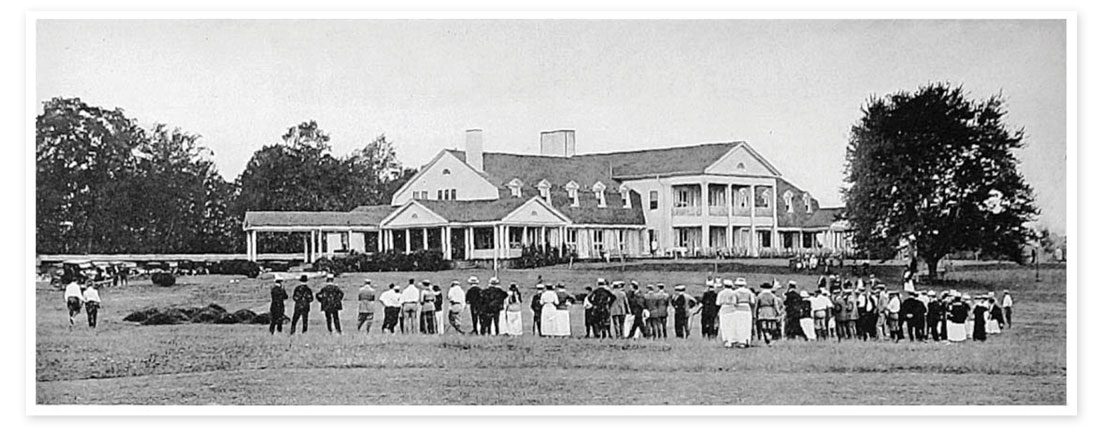
Brooklawn was established in spring 1895, mere months after the founding of the USGA. The club was birthed by a handful of businessmen in the neighboring city of Bridgeport, which in those days was a thriving metropolis and home to Remington Arms, Warner Brothers (which initially manufactured corsets and later became Warnaco) and Wheeler & Wilson (a sewing machine maker that the Singer Company eventually bought). Top executives at those and other enterprises in town wanted a place where they could recreate with their families. Once they formally incorporated the club, they rented some 60 acres of rolling farmland on the Bridgeport-Fairfield line. Then, they designed and built a nine-hole golf course along with a pair of bowling alleys, a baseball diamond, tennis courts and a trap shooting range.
Though golf was a relatively new sport in America at the turn of the 20th century, it quickly became the most popular activity at Brooklawn. So much so that the club ended up buying the property it had been leasing as well as additional acreage so it could lengthen and alter the course. Not long after that, in 1910, the club purchased a neighboring farm and expanded the layout to 18 holes.

Shortly after that work was completed, a 16-year-old, grade-school dropout who was working at Remington Arms stopped by the club to see about a job. His name was Eugenio Saraceni, and he had picked up golf at a local municipal course – and become quite proficient at the game. After watching the youngster hit balls, however, the club’s head professional pronounced himself unimpressed. But a couple of founding members, Archie and Willie Wheeler (of Wheeler & Wilson), liked what they saw and persuaded the pro to hire Saraceni as an assistant professional and clubmaker, at the salary of $8 a week.
Saraceni stayed at Brooklawn for two seasons, and it was only after he left that he changed his name to Gene Sarazen, because he felt that moniker made him sound more like a golfer. A few years later, in 1922, he really made a name for himself by capturing both the U.S. Open and the PGA Championship. But while his time at the club was short, Sarazen’s connection to Brooklawn and its members ran deep, especially after some of them had backed him when he first started playing on tour. He returned frequently for visits. During one such stop Sarazen set the professional record for the par-71 course by shooting 63, a mark that stands to this day.

Roughly a decade after the Squire had departed, the noted golf course architect A.W. Tillinghast came to work for the club. His task was simple: Revamp the pedestrian layout that initially had been fashioned by Brooklawn members. In time, the designer produced a plan that called for changing some 70 percent of the routing, adding a number of fairway bunkers and rebuilding all 18 greens and the bunkers that guarded them.
Tillinghast completed work on the course in 1932. And while he was not able to build most of the fairway bunkers he had included in his initial plans, due no doubt to financial difficulties caused by the Great Depression, he implemented the other alterations. The result was a far superior layout that boasted, in Forse’s words, “some of the best conceived and constructed green sites in the country, and some of the best Tillinghast ever built.”
The official opening was held in the summer of 1932, and among those who helped mark that occasion was Sarazen, who just five days earlier had captured his second U.S. Open, at Fresh Meadow Country Club on Long Island.
Talk to anyone who knows Brooklawn and they will tell you the greens are where all the fun is – where much of the challenge lies. The club’s current head golf professional, Jim Fatsi, describes them as “works of art,” and they are certainly that, well-contoured in most cases and canted from back to front. “They put a premium on accurate iron play and good, solid putting,” he adds. “You want to be careful about shooting for the pins and aim instead for the middle of the greens. And you want to be sure to keep your shots below the holes, especially if the greens are running on the quick side.”
Bill Wallace, a longtime Brooklawn member who previously chaired the golf committee and is slated to become the next club president, agrees. “Even if you get on the greens in regulation, par is by no means guaranteed,” he says. “And if you miss on your approach, you had better have a good short game. Getting up and down is no easy feat, especially if you short-side yourself.”

The course that Tillinghast produced also demands accuracy off the tee, given the old growth trees that line so many of the golf holes and how thick the rough can grow on the edges. And the heaving hills across which the track is routed have a habit of leaving players with uneven lies on their second and third shots. Then, there is the Rooster River, which runs through lower parts of the property and must be cleared on more than a few occasions during a round.
Remarkably, Brooklawn has a way of working well as a tournament venue and also a place for member play. The variety of tees ensure that it is approachable from a distance standpoint for golfers of all ages and abilities. And the course, which can be set up as long as 6,800 yards from the tips, can be toughened further for professionals and elite amateurs by growing out the rough and speeding up the greens.
Tillinghast’s original plan for the Brooklawn course, dated 1929, is framed and hanging in the men’s locker room. It speaks to the club’s rich history and deep golf culture. So does the fact that Brooklawn was one of the first dozen or so entities to join the nascent USGA. In addition, the club maintains a strong caddie program and continues to give back to the game by hosting national tournaments as well as regional championships for the Metropolitan Golf Association and the Connecticut State Golf Association. It also stages an annual four-ball tournament for top amateur competitors.

Perhaps most importantly, Brooklawn leaders keep taking good care of the golf course. Some 20 years ago, the club hired Forse to serve as its architectural consultant, and he has worked wonders. An extensive tree-removal program has opened up views and improved air flow and turf health. And the addition of new tees as well as several of the fairway bunkers Tillinghast long ago wanted to construct has improved angles of attack and enhanced the character of a course that already had lots of it.
All these years later, Forse continues to make tweaks to a layout that only seems to get better with age.
Now, that is something to celebrate.