

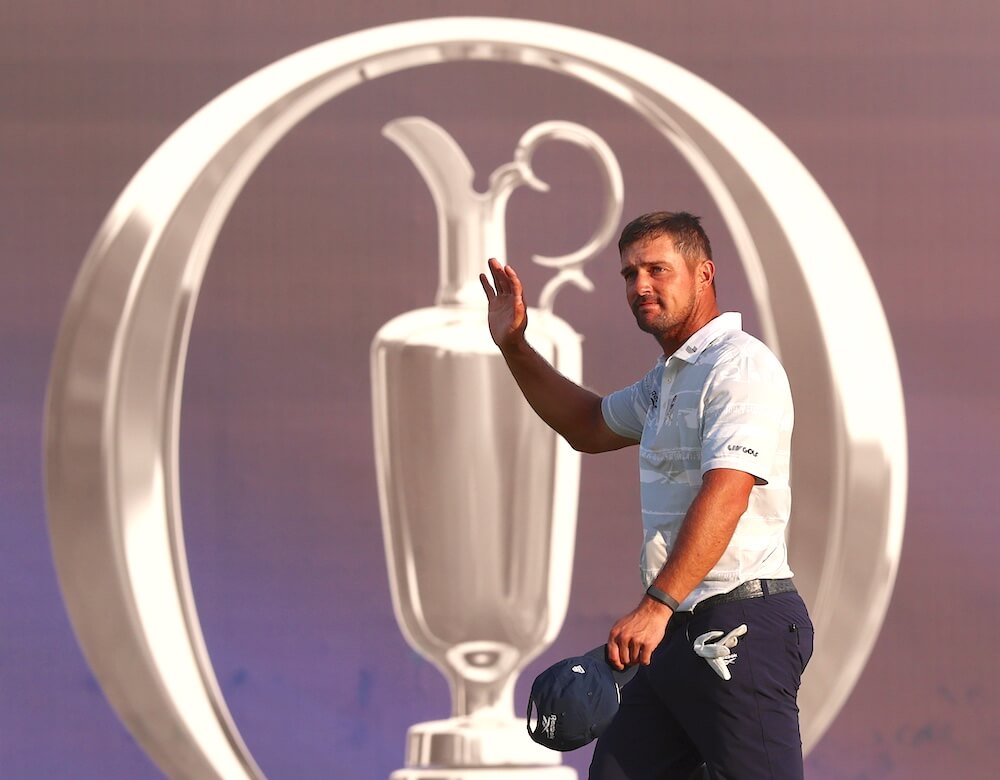
SOUTHPORT, ENGLAND | Friday at the 154th Open concluded with golf being more or less insignificant in comparison to the ongoing melodrama that is the life of Bryson James Aldrich DeChambeau.
And on Saturday absolutely nothing changed.
A third 62 of the week? The hometown hero Tommy Fleetwood making a charge? A packed leaderboard in the final major championship of the year?
None of it shifted the limelight from golf’s leading headline hogger for long.
Yes, New Zealand’s Ryan Fox was the man responsible for the 62 – the fourth time that score has been pencilled on a Royal Birkdale card in the venue’s last five rounds of major championship golf.
But a mere six reporters chatted to him afterwards.

And yes, Southport’s favourite son Fleetwood fired his way into the top 10, cheered on by joyously raucous galleries.
But DeChambeau dominated social-media interactions.
And yes, some of the world’s finest golfers – and a few lesser lights too – were engaged in an increasingly thrilling tussle for the right to lift the Claret Jug.
But most of them were posed questions about DeChambeau after completing their rounds.
Of course, you could blame golf’s media for the latter preoccupation, but the fact that fans on social media (and on the course) were talking mostly about the American demanded such an intensely narrow focus.
“From a rules perspective this was really clear cut. We understand there’s some emotion, we can all empathise, but from a rules perspective, this played out as we would hope.” – R&A chief executive Mark Darbon, on Sky Sports
And the gist of the matter? The 32-year-old had been docked two strokes for a rules infringement on the fifth hole of the second round when deemed to have improved his swing path by treading down long grass.
After being informed of the sanction, late on Friday evening, he immediately demanded a return to the exact spot where he had played the shot. Whilst there, television cameras showed him engaged in heated conversation with the rules officials.
It was suggested that he had threatened to withdraw from the championship and, after returning to the recorder’s hut, he remained in protracted discussions until darkness fell whereupon he marched to the range followed by reporters throwing questions at his back.
It was a remarkable scene and perhaps no film footage has been so profoundly scrutinised since Abraham Zapruder took his home movie camera to downtown Dallas in November 1963.
DeChambeau eventually posted on X: “Obviously disappointed with the ruling. I don’t agree with it, but it is what it is. This fires me up. Onto the weekend. Let’s get it.”
“From a rules perspective this was really clear cut,” countered the R&A’s chief executive Mark Darbon on Sky Sports. “We understand there’s some emotion, we can all empathise, but from a rules perspective, this played out as we would hope.”
Golf’s culture wars have driven a schism between traditionalists and rebels over the last four years, and the incident did absolutely nothing to calm the waters.
Rory McIlroy, who divides the warring factions as bitterly as DeChambeau, was straightforward in his analysis after he completed a third round of 69 that left him T29 on the leaderboard.
“I was watching it live,” he said. “I was in the players’ lounge watching it with a few other players, and as soon as he made the step into the ball, we all sort of looked at each other, and we were like – that didn’t seem right.
“Then when I heard that he was called in by the rules officials, it was pretty obvious why.
“I think there’s no doubt that he improved the line of his backswing. Whether it was careless or whether it was intentional, I don’t think it matters. Hopefully it was careless, but I think the two-shot penalty was justified for sure.”
“Look, I won’t pretend to be up here and defend Bryson, I’m not particularly fond of him. I think a lot of it’s performative. I think a lot of it’s for attention.” – Rory McIlroy
And then he doubled down.
“Look, I won’t pretend to be up here and defend Bryson, I’m not particularly fond of him,” he said, adding of the antics: “I think a lot of it’s performative. I think a lot of it’s for attention.”
DeChambeau’s determination to argue his point had delayed the signing of his card which in turn held up the publication of third-round tee times.
England’s Marco Penge had written on X: “Anyone know if Bryson is going to play tomorrow so we can get our tee times … ? I was up at 3:50 am, would be nice to get some sleep?”
“It was a late night for everyone,” said McIlroy. “To hold the tournament hostage like that, and to have all of us, players, volunteers, everyone waiting on him to depart, I didn’t feel like it was a great look.”

Scottie Scheffler was rather more cryptic.
“I don’t really have a ton to say on it,” he said before adding: “Actually, I do have a ton to say. I haven’t decided exactly what I want to say publicly yet. Just feel like it’s not a road I want to go down today.”
Jon Rahm was yet to see any film of the incident, but said: “For people who have seen all the images, I think the consensus is that, although it wasn’t intentional, it was an infraction. That’s what I understand, but I haven’t seen the video.”
He then added that some golfers thrive when dealing with significant off-the-course problems – and that DeChambeau had done so when winning LIV Golf events in Singapore and South Africa earlier this year.
“Some of those things I wouldn’t wish on anybody,” he explained. “And he was able to perform incredibly well.”
Out on the course Saturday, the man himself was providing a reminder of that resilience because while most players under such intense scrutiny would have struggled, the two-time U.S. Open champion carded a 69 to end the round in a share of sixth, four shots off the pace.
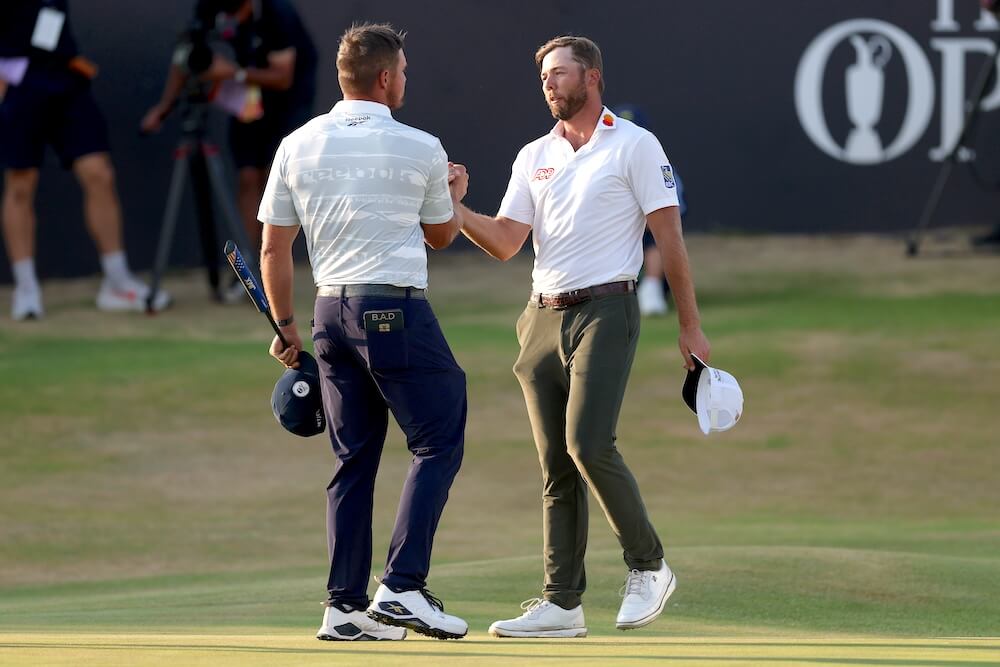
He is also immensely popular because while there were catcalls thrown his direction on the course, there was also plenty of vociferous support, including from his playing partner Sam Burns, who believed there had been insufficient evidence for the penalty strokes.
“Bryson showed a lot of grit out there,” he said. “I was impressed.”
Burns had a fine day himself, posting a 65 and taking the lead, two strokes clear of Fox and Si Woo Kim (67) on 10-under 200. Ryan Gerard (69) and second-round leader Lucas Herbert (71) were another stroke back in joint fourth.
Burns, the 29-year-old Louisiana native, has been the nearly man of major championship golf over the last 24 months.
He was second after 54 holes in the 2024 Open at Royal Troon before carding a final round 80. He led last year’s U.S. Open after 36 and 54 holes before a Sunday 78 derailed his challenge. He shared the first-round lead at Augusta National in this year’s Masters ahead of finishing in a share of seventh.
And a final-round charge at Shinnecock Hills last month was enough to defeat everyone in the field except the champion Wyndham Clark.
He didn’t expect to compete this week because his wife was expecting their second child during the championship, but the birth of daughter Belle 11 days early allowed him to travel at the last minute.
Asked if he had heard of the nappy factor – the theory that a golfer is never more dangerous than shortly after the birth of a child – he was curious, but added: “If I had been aware of it I’d have eight kids by now.”
This week, at least, two might be enough.