


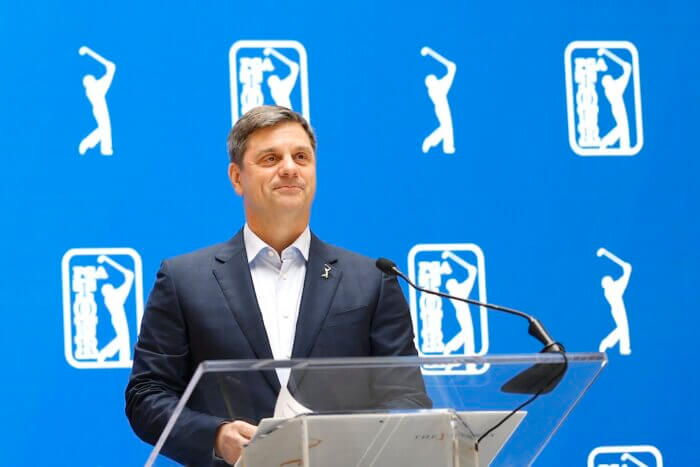
DUBLIN, OHIO | Brian Rolapp stood at the front of the interview auditorium at the Memorial Tournament Wednesday morning, surrounded by a semicircle of media members, there to quiz the PGA Tour’s CEO about the progress being made toward remodeling the tour’s competitive structure.
Rather than take a seat behind the desk on the auditorium stage, Rolapp settled for a more informal exchange, indicative of the message of the moment.
The big reveal, or at least as much of it as will have been cemented, is scheduled for June 23, the day after a PGA Tour Policy Board meeting, at the Travelers Championship where Rolapp has promised to deliver as much detail as possible.
At the Memorial, where Rolapp had other duties including joining the event’s prestigious Captains Club meeting, the message was more general while confirming reports that a two-track tour is likely coming in 2028.

There are more meetings to be had and more fine-tuning to be done but the foundational pillars for a reimagined tour are falling into place. How much is official when Rolapp meets the media after the U.S. Open depends on how much work gets done between now and then.
“I’ve been incredibly impressed with the players about how much time and thought they have put into it. And I think we have a lot of work to do [before June 23],” Rolapp said.
“But the amount of change and the questions we’re asking ourselves are not easy by design. But I think we’re making substantial progress … I think we’re on pace.”
It won’t happen next year but the idea of having approximately 24 events including the majors along with a new playoff structure for 120 to 130 players has been generally agreed upon. There is still the matter of determining which tournaments will be $20 million Track 1 events and which will be on the second, less-lucrative track where a still undetermined number of players will compete.
Rolapp wants a simpler end-of-season structure and he praised players for taking the initiative to come up with something new. Exactly what that will be, Rolapp said, has not been determined but there is another meeting about it on June 9.
Negotiations are continuing between the PGA Tour and the DP World Tour about extending their strategic alliance, and Rolapp expects the tour to have new media rights deals long before the current deals expire at the end of 2030.
This was never going to be easy or quick.
“I feel good where we are, but I also had expectations that it wasn’t going to be easy … In the sort of experience of my old job, any substantial change we made always came with a lot of work and a lot of attention to the process. You don’t have a good process if there’s not tension. That means you’re not asking the right questions. And so I think we’ve reached that, which I think is a very good thing,” Rolapp said.
“It doesn’t mean everyone loves everything, but I think everyone sort of gets why we’re doing this and the direction we’re going. I think there’s a decent consensus on that. And then there’s all the details about how you effectuate. There’s always going to be different views on that.” – Brian Rolapp
The big change is creating an elevated level on the tour for the top players, the idea being to bring them together more often. That doesn’t mean Rory McIlroy and Scottie Scheffler will tee it up every time but the idea is to heighten the focus, interest and relevance of those events.
Getting the general buy-in from players on such a substantial change has taken time and there are still details to refine before anything becomes official.
“It doesn’t mean everyone loves everything, but I think everyone sort of gets why we’re doing this and the direction we’re going. I think there’s a decent consensus on that. And then there’s all the details about how you effectuate. There’s always going to be different views on that,” Rolapp said.
Still under consideration is whether there will be relegation/elevation during the season or strictly after both seasons are complete. Increasing the consequences of good or poor play is part of what is driving the changes.
Asked specifically how much relegation he envisions, Rolapp said, “Substantial enough to matter … I think you’ll see people fighting to stay on Track 1.”
The CEO stopped short of saying the signature events next year – which seem likely to remain around eight like this year – will have larger fields and 36-hole cuts. It may be 2028 before every Track 1 event has bigger fields. Sponsor exemptions for signature events next year and beyond are also still under discussion.
How many players will be eligible for Track 2 events, which will have significantly smaller purses, is still being determined. Many of those tournaments will be stand-alone events on the schedule, while some could be scheduled on the same weeks as Track 1 tournaments, particularly during the summer.
Rolapp said there is enough interest from sponsors at both levels to move forward.
As for the postseason, tour insiders stress an interest in moving away from the current lineup which features tournaments in Memphis, St. Louis and Atlanta in the heat of August. There is also a desire to go to highly regarded venues, some of which could be a surprise, while probably changing the format.
“I’ve been a big believer that you can come up with any format you want, if it doesn’t feel authentic to the players, like it’s real authentic competition, it’s not going to feel authentic to anybody. And most of the ideas now about how to actually think about formats for the players are coming from the players, which is great,” Rolapp said.