


SOUTHAMPTON, NEW YORK | The distance issue, which has bedeviled golf administrators for years, has taken another twist with the announcement Wednesday that options beyond a potential ball rollback will be reconsidered prior to an intended implementation in 2030.
Though the USGA announcement, made in conjunction with the R&A, the PGA Tour and the DP World Tour, was short on specifics, it is clear that a broader menu of options will be considered with an emphasis on still meeting the 2030 goal.
The announcement cited three key outcomes after an extended period of discussion across the industry: “(a) recognition that distance continues to increase at the elite level; (b) a concern by the Tours that the updated [Overall Distance Standard] testing approach may not achieve the desired results; (c) a collective willingness to reconsider alternative approaches that may more materially impact the pace of future distance increases, while minimizing disruption to the overall golf market.”
In other words, the proposed rollback criteria may not be enough and there is interest in hearing from more than the governing bodies, including from the PGA Tour and its players who have indicated they are not in favor of a rollback but open to alternatives.

Guidelines that were set to be implemented for elite players in 2028 were shifted back to 2030 and now, though the date four years down the line remains, exactly what happens and how significant its impact might be is still a mystery.
What became clear with the Wednesday announcement is options that had been off the table are being reconsidered, and doing something by 2030 is still the goal. Doing it collectively is paramount, USGA CEO Mike Whan said.
“We’re starting with distance is increasing. We don’t want the game to become even further one-dimensional,” Whan said.
“Then leading to ideas, I got to tell you, in my five years of this job, I haven’t had those meetings until recently. You could take the angle of, well, it’s been five years, and nobody is helping, and so Heisman, no, thank you. Or you can say if we could get to something better together, wouldn’t that be great for the game?”
The game’s governing bodies have been intent on maintaining one set of rules for all players, which has limited how much the changes would affect tour players.
The game’s governing bodies have been intent on maintaining one set of rules for all players, which has limited how much the changes would affect tour players.
The USGA brass did not specifically identify what options might be revived but by opening the door on considering modified local rules it would allow for the use of a tournament ball at the highest level, though there has been long-standing pushback from manufacturers and purists who don’t want bifurcated rules.
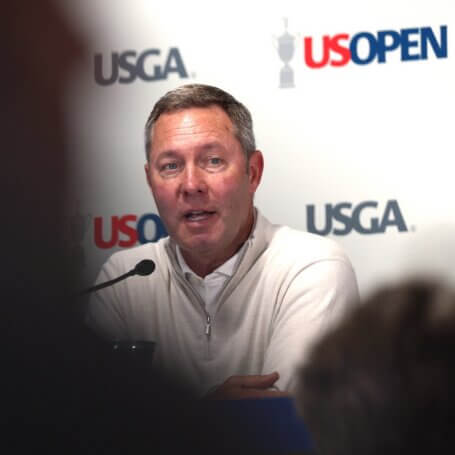
“Three years ago we were told pretty point blank that MLRs would not be implemented that are distance-related at the PGA Tour level. Given that, we had a crossroads. Do we keep going down that path if they’re not going to be implemented? That’s a paper exercise then. So we moved on from some of those,” Whan said.
“Clearly that mindset has shifted.”
It also raises the question of whether tighter restrictions on drivers will be considered. While the focus has been on limiting the ball, many have suggested the bigger issue may be with drivers, which have become more powerful and easier to control, effectively changing how the game is played, particularly at the highest level.
The USGA announced in late 2023 it was not actively studying changes to drivers as part of its program.
When the U.S. Open was played at Shinnecock Hills in 1995, the average driving distance that week was 263.3 yards. The PGA Tour average this year is 302.9 yards, creating a drastically different way to play one of the game’s most respected layouts.
When Cameron Young hit a 375-yard drive on the 72nd hole of his Players Championship victory in March with a ball that reportedly would conform under the proposed new guidelines, it brought the effectiveness of the potential changes further into question.
“It probably isn’t enough, and we’d have to do other small, digestible bites in time, too, but I think as an industry, we want to be able to get through those.” – Mike Whan
After meetings at the Memorial Tournament earlier this month, including interaction with the PGA Tour’s Player Advisory Council followed by a demonstration from a top player about how little impact the proposed rules would have at the game’s highest level, the path forward turned again.
“We knew … that if we were going to do an across-the-board change, it could only be as far as it could be to have no impact on the recreational game,” Whan said. “I view the ODS ball change as a small, digestible bite that the industry can handle. It would be small. It’s not horrific.
“As I’ve said this many times in many interviews, it’s fair to critique whether or not it’s enough. It probably isn’t enough, and we’d have to do other small, digestible bites in time, too, but I think as an industry, we want to be able to get through those.”
Whan added that the target date for implementation remains 2030, which means whatever else might be coming would need to accelerate what has felt like an overly deliberate pace.
Whan said he believes the limitations on the ball that are set to go into effect in 2030 will have the desired effect of reducing the continual increase in driving distances over the long term but would not lead to a drastic reduction in distance.
“We’re leaving 2030 on the table. So when we talk about other approaches, we want to be doing that with the speed of saying, you know, if we were going to do something other than 2030 or in addition to 2030, we need to know that sooner than later,” Whan said.
“So it creates a sense of urgency for all parties. This isn’t another eight-year effort. We need to get at it and do it with a sense of urgency.”