

On Wednesday, Jack Hall and David Millis were announced as the newest inductees into the National Senior Amateur Hall of Fame. But while Millis was present in High Point, North Carolina, for the ceremony, Hall was not. About a month ago, Hall’s life was flipped on its head.
Following an emergency room visit and a CT scan, doctors discovered a cue ball-sized mass on Hall’s jejunum, a section of the small intestine. Originally, the radiologist predicted Hall had a gastrointestinal stromal tumor, which gave Hall a grim picture.
“When you look at that and you think four months to 12 months, your life goes into turmoil,” Hall said.
But after surgery that removed the mass, the pathologist gave Hall favorable news. It was lymphoma, still cancer, but treatable with chemotherapy, which Hall started a week after Memorial Day. While he was lying in his hospital bed, the former No. 1 senior amateur’s phone was continually lighting up. Hall’s impact on amateur golf goes far beyond the course.

“I hope I don’t get choked up,” Hall said. “I was on my back for eight days. And in those eight days I probably had 400-500 texts from all over the country. It humbles you. Yeah you can be competitive, but at the end of the day I love these guys. It’s a tight-knit family with a common bond over the love of golf.”
Hall didn’t grow up in a family of means, so he looks back with appreciation on his dad’s decision to join Druid Hills Golf Club in Atlanta when Hall was 10.
“I remember that the initiation fee was $500 and that was a stretch for him,” Hall said. “But he did it for us. And you look back now and I’m sure that my family didn’t go on a lot of vacations at all to allow me and my brother the opportunity to play golf.”
At the same time Hall started hitting balls, he started working on the golf course to earn extra money. Now a real-estate developer, he says he’s never been without a full-time job.
Hall played his first tournament at age 12 and instantly fell in love with competing. That competitive fire still burns strongly today.
“I cut grass in the neighborhoods and worked on and around the golf course, especially on the driving range,” Hall said.
Hall played his first tournament at age 12 and instantly fell in love with competing. That competitive fire still burns strongly today.
“I don’t even keep up with the tournaments I’ve won and lost,” Hall said. “I’m just a guy who feels so lucky to be able to play. I love competition. I don’t really enjoy just going out and playing golf, but to play against someone or to play against a field is what drives me.”
After attending the University of Georgia, Hall briefly entertained a professional golf career and tried PGA Tour Q-School twice. He even Monday qualified for a handful of PGA Tour events. But he ultimately realized that life wasn’t for him.

Instead, Hall learned how to market real estate, which allowed him to keep playing golf for business. In 1983, he married his wife, Gay, and the couple later had two children. Amid familial responsibilities, Gay always supported her husband’s love of golf.
“Even with raising two kids, she always wanted me to take a few minutes, maybe hit a bucket of balls or do whatever,” Hall said. “But she has always been my biggest fan and biggest promoter for maintaining my golf.”
Hall moved to Savannah, Georgia, in 1995 and his family came a year later. There he met Doug Hanzel, who would later win the 2013 U.S. Senior Amateur. The two were instantly competitive.
“I’d heard of this doctor who was a real good golfer but never really played against him,” Hall said. “And people thought we were antagonistic to each other because we were competitors. Nothing could have been further from the truth.”
When Hall turned 55 and became eligible for senior events, he suggested that he and Hanzel travel to tournaments together. The two became great friends and won three Georgia Senior Four-Ball Championships together (2015-2017).
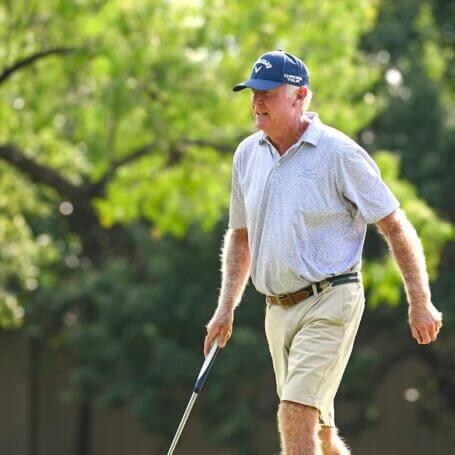
“I think there are months where I’ve spent more time with Jack than with my wife,” Hanzel said.
When Hanzel has diabetes-related health issues, Hall is there.
“Sometimes he’s had episodes that if he had been by himself it would have been scary but he’s been with me so we’ve looked after each other,” Hall said.
When Hanzel learned Hall was sick, he says he was devastated. With more than 40 years of medical experience, Hanzel wants to help in any way he can.
“I’ve taken care of very ill people and have experience with cancer,” Hanzel said. “My own wife has had breast cancer and has gone through chemotherapy so we’ve experienced a lot of what he’s experiencing and hopefully we can be a resource for him and Gay.”
When Hall couldn’t attend the hall of fame ceremony due to chemotherapy, Hanzel spoke on his behalf, returning the favor for when Hall spoke upon his 2019 hall induction.
When he learned of the honor, Hall didn’t think he belonged.
“My initial reaction was no thank you,” Hall said. “David Millis said we want you in the hall and I said, ‘David, I’m not a hall of famer.’”
“He’s very generous with his time and money and really doesn’t want to be recognized for it. And that’s why he’s kind of shied away from any awards like a hall of fame because to some degree he doesn’t feel like he deserves it but he definitely does.” – Doug Hanzel
Hall pointed to his lack of USGA championship victories, which many hall of famers have on their résumés. But Hanzel says Hall is more than deserving not only for his playing accomplishments but his philanthropic efforts, especially on behalf of the Georgia State Golf Association.
“He’s very generous with his time and money and really doesn’t want to be recognized for it,” Hanzel said. “And that’s why he’s kind of shied away from any awards like a hall of fame because to some degree he doesn’t feel like he deserves it but he definitely does.”
Hall says that if there’s something he’s most proud of, it’s his longevity. When he was in college, he saw a 30-year-old playing golf and thought how lucky he’d be to still be playing the game at 30. And now, at 68, he says he has hit golf balls almost every day of his life since he graduated college.
“I can’t believe I’ve carried this sport through my life,” Hall said. “I love this sport. I love what it represents. I love the integrity that comes along with it. I’m going to get through this chemo so I can play golf again. I’m going to be competitive again. I’m going to beat somebody.”