

NORTH NAPLES, FLORIDA | With so much attention focused on the golf course boom on Florida’s Atlantic coast, it is not surprising that new developments on the other side of the state are overlooked. Which is a shame, for there are some beauties coming on line here, chief among them the Kinsale Golf Club in this Gulf Coast community at the western terminus of I-75, which is also known as Alligator Alley in these parts.
Kinsale’s centerpiece is a Gil Hanse-Jim Wagner layout. Opened in the fall of 2024, its design was inspired by the Old World template holes Charles Blair Macdonald and Seth Raynor interpreted so brilliantly in their work a century or so ago. And that seems fitting considering that Kinsale takes its appellation from a town on the southern coast of Ireland that is home to the heralded Old Head Golf Links.
On the land that is home to its American namesake, Hanse and Wagner have created a Knoll, a Redan, a Biarritz, a Double Plateau and a shortish 3-par Punchbowl at No. 16 that is as fun as a log-flume ride. Together, they make each loop around this par-71 track feel like a heritage tour of the game’s Golden Age as well as an engaging round of golf.
Equally alluring is the St Andrews-esque crossing of holes on the back nine of Kinsale, with golfers having to hit their tee shots on the par-3 13th over the fairway of No. 12, much as they must do during a round on the Old Course in the Home of Golf. And when you toss in near-constant winds and the well-considered humps and bumps that Hanse and Wagner fashioned on what once was tortilla-flat land, you have a modern track with Old World soul – and a place that is a joy for golfers of all levels to play, even if it sometimes beats them up in the process.

You also have a course that stands up to anything recently built on the other side of the state – and a club whose members appreciate the game in its most traditional forms, with most golfers walking with caddies, and most rounds played in 3½ hours or less. The track is conditioned to play firm and fast, and most greens are very receptive to run-up shots. But should you miss, there are lots of run-off areas around the putting surfaces that call for considerable creativity when it comes to getting up and down.
And instead of a practice facility, Kinsale boasts what members call a “warm-up range,” which in my way of thinking when it comes to pre-gaming sounds exactly right.
“The goal was to create something fun, like a summer club in New England, an understated place with holes that are very natural in how they look and sit in the landscape and have a feel of genteel neglect around the edges but with well-manicured tees, greens and fairways,” said Wagner, a native Philadelphian who now resides in Palm Beach Gardens, Florida, which allowed him to visit the Kinsale course more than 100 times during its design and construction. “And we thought that using the templates was a way to turn this rather bland piece of property into something quite interesting.”
“What Gil and Jim did was turn a swamp into a very good and incredibly strategic golf course that feels a lot bigger than it actually is.” – Tom Stacy
Mission accomplished, as far as Steve Archer, Kinsale’s director of club operations, is concerned.
“It is certainly interesting,” said Archer, a protégé of longtime Oakmont Country Club head pro Bob Ford who cut his teeth as an Oakmont assistant before taking on the top jobs at Frederica Golf Club on St. Simons Island in Georgia and Capital City Club in Atlanta, among other places. “Enjoyable, too, and unlike anything else down here.”
Kinsale was conceived and constructed by Tony Soave, a Detroit-based residential and commercial real estate developer who has also built luxury condominiums in southwest Florida.
Soave had intended to construct housing on this 174-acre parcel, about a third of which is wetlands. But when that project got hung up in the regulatory process, he decided to pivot and create a golf club instead, eventually hiring Hanse and Wagner to craft the course.
That was an unexpected move in some ways, for Soave is not a golfer. But he is first and foremost a businessman and saw the game as a way to salvage his investment.
“What Gil and Jim did was turn a swamp into a very good and incredibly strategic golf course that feels a lot bigger than it actually is,” said Tom Stacy, a founding member of Kinsale and a past club president at Oakland Hills outside Detroit.
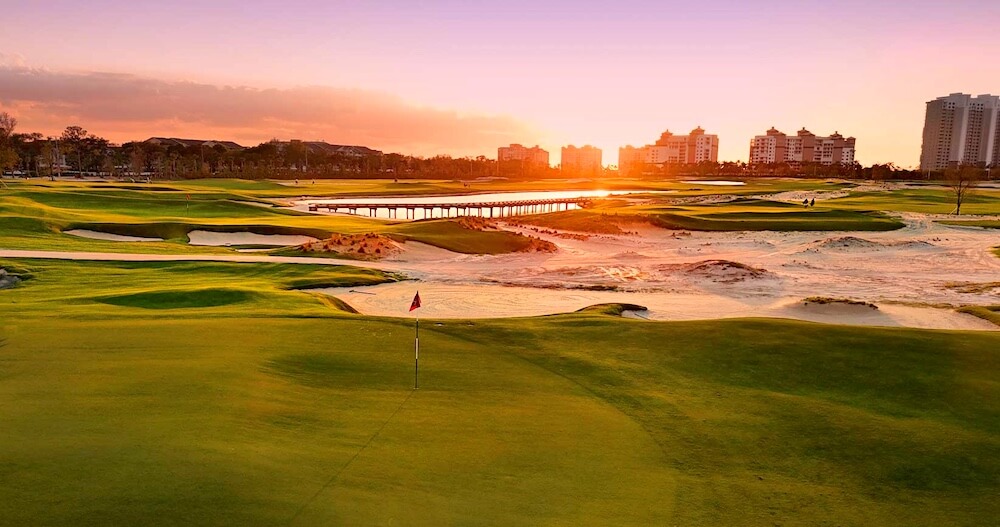
Tim Hildebrand, another of Kinsale’s original members who also led Oakland Hills as its president, agrees, adding: “It also plays differently every day, due largely to the ever-changing wind and the way the golf balls react to the ground.”
Chris Hall, a sixtysomething West Texas native and charter member at Kinsale who has lived full time in this area for the past 11 years, is certainly pleased with what the architects have created.
“I’ve been around,” he said as we played the course one sunny morning last March. “And I have never seen anything quite like this.”
Truth be told, neither have I.
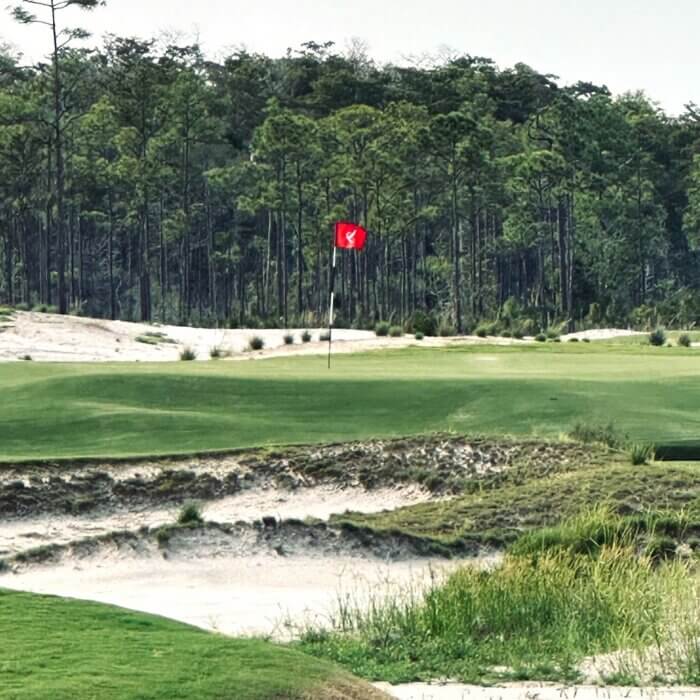
Boasting four sets of tees, with the back markers measuring 6,802 yards on the scorecard, Kinsale sets itself apart right from the start with a pair of very different par-5s. The first is a bit of a beast at 588 yards from the tips, with two sets of cross bunkers positioned to wreak havoc on a player’s drive and second shot if he is the least bit inaccurate and a green that lies low to the ground. The somewhat shorter second hole, at 505 yards, runs perpendicular to the opener and plays to a slightly raised putting surface that is backed by one of seven ponds on the property and guarded by four of Kinsale’s 154 bunkers. At roughly 300 yards, the Hogback at No. 3 is a short but testy par-4. Then comes Redan and after that Double Plateau, with both greens full of undulations, followed by Leven, Biarritz and finally Raynor’s Prized Dogleg.
I marveled at how Hanse and Wagner had interpreted these epic holes and the different shots they compelled me to hit, to say nothing of the smiles they brought to my face as I attempted to execute them. I relish that style of golf and realized after we had completed the front nine that I had already hit most every club in my bag.
I was also struck by the sheer incongruity of the setting. The design of the golf holes and the firm and fast way the rumpled fairways played, thanks in part to the designers’ sand-capping the entire course before they started growing grass to ensure it drained properly, was so old school. So was the sight of every other group on the course walking with caddies. I liked the short distances between the greens and tees. And the sound of the Irish brogues in which the two loopers in my foursome spoke only reinforced the sensation of walking an Old World links.
But whenever I looked at the high-rise condominiums that rose beyond the borders of the club property and the stands of palm trees rising in the distance, I was reminded that I was indeed in southwest Florida.
I had no problems with that, however, given the quality of the track.
That ability to get golfers to interact was one of the things that led the designers to fashion a Punchbowl on No. 16 with the green backed by the clubhouse, so people in that structure could watch with those playing the hole and see how the tee shots turn out.
One of my favorite parts was that back nine crossover, with those teeing off on the par-3 13th, a rendition of the Postage Stamp at Royal Troon in Scotland, hitting their tee shots over golfers coming up to the green of the par-5 12th that Hanse and Wagner modeled after the fabled Bottle hole on the Old Course at Sunningdale outside London.
“We liked how that feature evoked St. Andrews and gave players from different groups a chance to connect on the golf course and maybe even give each other a bit of grief as they walked by,” said Wagner.
That ability to get golfers to interact was one of the things that led the designers to fashion a Punchbowl on No. 16 with the green backed by the clubhouse, so people in that structure could watch with those playing the hole and see how the tee shots turn out.
That was just one more deft move on the part of the architects here – and one more thing to commend this Gulf Coast gem and the good work being done golf-wise in this part of the Sunshine State.