

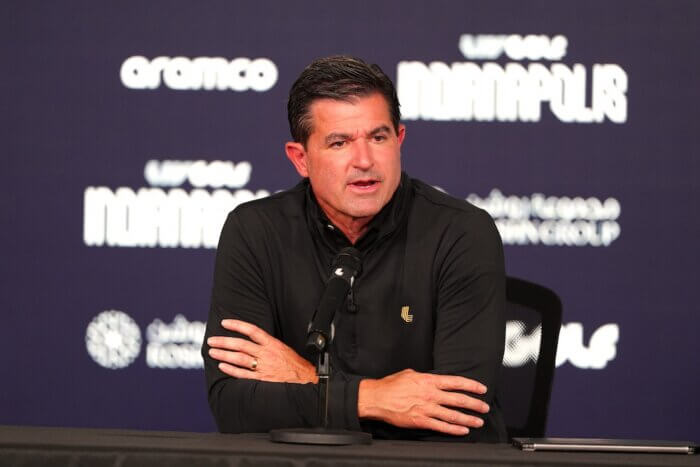
Depending on your level of optimism/pessimism, LIV Golf’s event in Indianapolis that begins Thursday could be a not-so-grand finale for the league, which finds itself – optimistically – at a crossroads or – pessimistically – at a dead end.
Even Ted Lasso would have a hard time finding a silver lining in the LIV mess.
Whether by design or human nature, LIV Golf has had a gift for drama, primarily off the golf course and as it arrives in the American heartland for its last event of 2026, the overriding question remains what’s next beyond the relative indifference of American golf fans.
Earlier this week, LIV Golf confirmed that its team championship scheduled to be played next week in Michigan has been cancelled and the event will be rolled into the Indianapolis tournament. The individual purse this week is $10.1 million, a little more than half of what it was for the previous LIV event in New Jersey; the payout for the season-ending team championship is $30 million, down $10 million from what was to be paid out in Michigan.
If you are envisioning money circling down a drain, you are not alone, as reports circulate that some players have not been paid for the most recent tournament and vendors who haven’t been paid for months are pursuing legal action.

CEO Scott O’Neil recently announced that new funding has been found to assure what is being pitched as “LIV Golf 2.0” next year and beyond. Should that funding come through, it feels like more a tourniquet than a transfusion now that the Saudi money has been turned off.
The check, it’s fair to assume, is not yet in the mail though O’Neil doubled down Wednesday on a new day dawning for LIV. He sidestepped a question about when a deal must be finalized, having earlier pointed to Sept. 1, focusing on possibilities rather than potential inevitabilities.
“We have work to do. We have things we have to accomplish. There are hurdles we have to jump over. It’s a very complex transaction we’ll have to deliver.
“But man, I wouldn’t bet against us,” O’Neil said.
If a potential backer has agreed to pony up something in the range of $250 million it would seem contingent on Jon Rahm and Bryson DeChambeau agreeing to continue with what is said to be a 10-event season next year.
That’s not an exacta worth betting.
Rahm rejected the PGA Tour’s supposedly one-time offer to come with Koepka earlier this year, likely because his contract didn’t have the necessary wiggle room, but with a potential LIV bankruptcy filing ahead, Rahm will have new options.
Rumors are swirling that Rahm now has a way out of his LIV deal to potentially return to the PGA Tour, through a Brooks Koepka-like agreement but with a higher buyback, some say as much as $25 million.
Was it coincidence that a social-media post from LIV about this week’s event featured DeChambeau, Joaquin Niemann and Dustin Johnson but not Rahm?
As much as DeChambeau likes to be the needle mover, Rahm is the LIV golfer who makes the most difference beyond the YouTube generation. Losing Rahm would be crushing for LIV.
Rahm rejected the PGA Tour’s supposedly one-time offer to come with Koepka earlier this year, likely because his contract didn’t have the necessary wiggle room, but with a potential LIV bankruptcy filing ahead, Rahm will have new options. The PGA Tour has been careful to steer clear of talking to players under contract, intent on avoiding any tampering claims down the line.
This can be Rahm’s moment to rewrite his career narrative. He’s in his golfing prime and being unburdened by whatever emotional weight that seems to have persisted since he left the PGA Tour could feel like a life reset.
Having already demonstrated his willingness to make accommodations to benefit the PGA Tour, CEO Brian Rolapp is in a position to do it again with Rahm and, perhaps, others.
Rory McIlroy openly questioned how much their return might impact the PGA Tour.
“I would argue, have they brought value to LIV?” McIlroy said Wednesday at the BMW Championship, a stance he’s expressed previously.
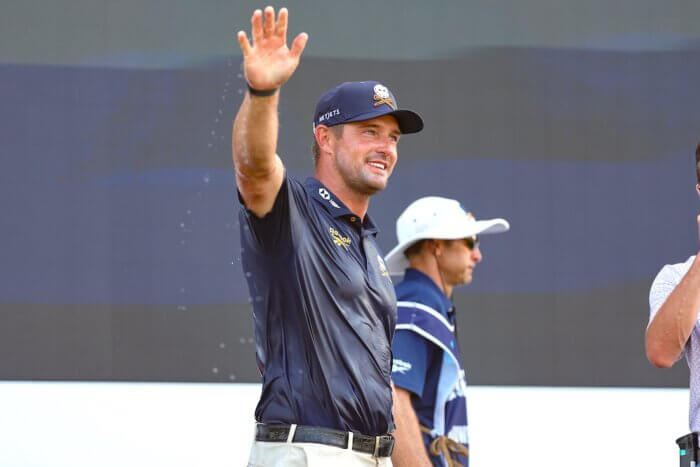
For DeChambeau, whose contractual ties to LIV end with this season, the question is more complicated. He is a polarizing star without many allies at the PGA Tour and he has been openly critical of the tour’s response to LIV.
With LIV’s future hanging in the balance, DeChambeau has reportedly been lobbying players to stay with him but it’s a tough sell. Even Ian Poulter, one of LIV’s staunchest advocates, acknowledged in a recent online interview that the league’s days could be numbered.
It’s no surprise that several players are considering their options and, if this is their last LIV event, the one-year penalty clock imposed by the PGA Tour can begin ticking on Monday.
A handful of LIV players – Peter Uihlein, Michael La Sasso and Josele Ballester – have added their names to the list of entrants for the DP World Tour’s qualifying school later this year, another hint at what’s coming.
When O’Neil announced a new investor was riding in to save LIV Golf, he did it with confidence but precious few details.
Whatever momentum LIV Golf ever had is long gone and the league feels increasingly irrelevant.
In the announcement Monday that the Michigan event would not be played, O’Neil said in a statement it will allow LIV to “put our full resources behind what comes next and maintain the operational rigor this transition demands.”
Good luck with that. Whatever momentum LIV Golf ever had is long gone and the league feels increasingly irrelevant.
LIV Golf was founded on audacity and the Public Investment Fund’s billions. It rattled the game and restructured the landscape. It brought politics into the equation, gave Greg Norman a deep pocketbook and a pulpit and it’s where Phil Mickelson seemed to fade to black.
At the Club at Chatham Hills just north of Indianapolis, LIV Golf is doing what it does again this week. The music. The hospitality. The team competition.
What matters is what happens next.
Will “Golf Only Louder” endure or will it go quiet permanently?
The clock is ticking.