

SOUTHAMPTON, NEW YORK | Among the many words used to describe U.S. Open setups through the years, benevolent has likely never made the list.
It runs contrary to the U.S. Open’s unwritten but understood ethos of leaving no stone unsharpened, no edge too dull, no rivet too loose.
And yet, like so many things in a world that’s changing as quickly as AI can change it, the first round of the U.S. Open at fogbound then windswept Shinnecock Hills was defined by the USGA’s – what’s the word? – let’s call it benevolence.
Grace works, too.

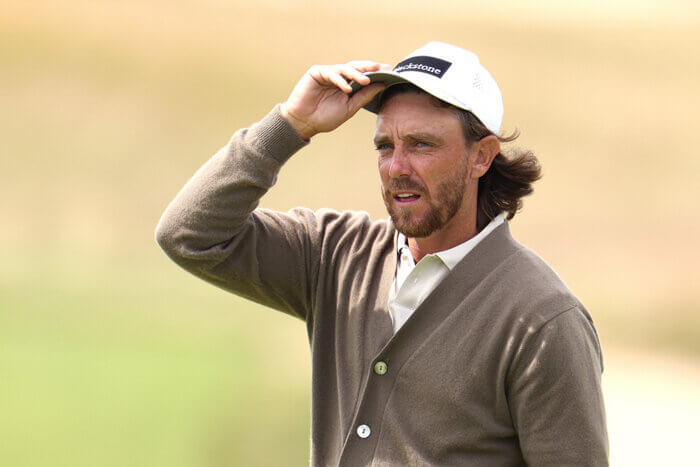
“I don’t think anyone would want to play it any harder than what it was. I think they did an amazing job of making it as fair as you could possibly make a test of golf with the conditions they had today,” Tommy Fleetwood said after opening with an even-par 70 in the blustery conditions.
Keith Mitchell shot 6-under-par 29 on the front nine (his second nine) on his way to an opening 70 and while there is every reason to believe a 72-hole score around even-par 280 on Sunday may be good enough to hug the silver trophy, the USGA followed through on its promise to be conservative rather than aggressive with a course that, on its softest day, can be a beast.
It’s not as if an American Express-like shootout unfolded at Shinnecock but neither was it as bleak as a Cormac McCarthy novel. Good shots were rewarded. Bad shots were penalized.
The wind blew hard but not quite as hard as feared. Like steak knives compared to machetes.
With holes cut into more accessible locations to account for the wind and its potential to suck the moisture out of the putting surfaces, it felt more like a high-wire act with a net rather than no net.
Shinnecock started green and stayed green. That may not be the case this weekend.
“I think they set up the golf course pretty well. There’s only so much they can do,” said Sam Burns, who knows all too well how hard-line the USGA can be after his chance of winning at Oakmont last year drowned in what appeared to be casual water on Sunday.
The championship was half an hour old when horns sounded from somewhere in the gray-white fog, stopping play for two hours. Having spent an inordinate amount of time on Wednesday explaining the USGA’s plans for dealing with various weather conditions, officials didn’t mention the possibility of the fog that socked in Shinnecock like a good snowstorm.
The morning dampness did not spare the USGA the task of syringing the greens midday – more evidence the organization has learned it can never be too cautious – while it made a long day feel longer.
As for the winds, forecast to hit Shinnecock like a jackhammer, like most headaches, they could have been worse.
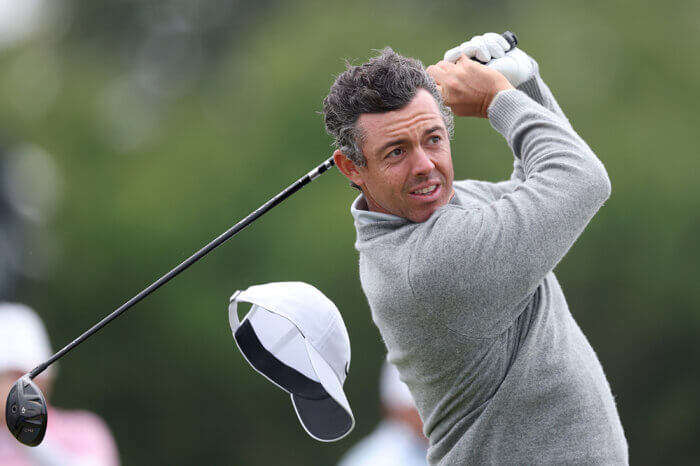
“I think they were prudent with the course setup,” said Rory McIlroy, who shot 1-under 69 despite bogeying his last two holes. “I think especially with starting with 156 [players] the first two days, you just want to get everyone around without too much issue. They’ve set the course up for that, at least today.”
“When the wind is this strong and if it’s ever across, you’re going to fight it because you can’t just let the ball go because it will be out of control. There’s always an element of holding it up.” — Tommy Fleetwood
Softer did not mean easy. The wind, coming generally from the southwest and creating multiple shots into crosswinds, factored into virtually every swing.
Burns described his second shot into the uphill green on the par-4 ninth. Facing 170 yards with a right-to-left breeze, Burns debated fighting the wind with a cut or riding it with a draw.
“If I slice it up into [the wind], it could go 150 and if I draw it, it could go 195. I don’t think people have quite the understanding of how difficult those shots are,” said Burns, who ultimately missed the green to the left before saving par.
Fleetwood wrestled with the equation through the gusty day.
“When the wind is this strong and if it’s ever across, you’re going to fight it because you can’t just let the ball go because it will be out of control. There’s always an element of holding it up,” Fleetwood said.
“There’s a feel to that and an element of calculation. You pick what you feel is right and hope you hit the right shot.”
There were moments when the conditions conspired to help players. It happened for McIlroy at the par-5 fifth where he hit a 396-yard tee shot followed by a 192-yard pitching wedge to 11 feet, setting up an eagle.
World No. 1 Scottie Scheffler, in his first attempt to complete the career Grand Slam, never developed much momentum on his way to an opening 72.
Asked how he felt about the Shinnecock setup, Scheffler didn’t have much to offer.
“Setup? I don’t know,” Scheffler said.
“I would say the greens were maybe a little softer than I expected, but I think with the wind that was forecasted, you’ve got to – you always want to err on the side of caution.”