

SOUTHAMPTON, NEW YORK | U.S. Open courses are demanding. Of course they are. They are meant to be. But while some are difficult to like, others are easy to love. Merion, for example, is beguiling on account of both its course and clubhouse, and the quality of Pinehurst No. 2 set amidst the chocolate-box town of Pinehurst makes it one of my favourites.
Olympic overlooking San Francisco? Yes, that’s a memorable venue too if we can forgive those sloping fairways. Baltusrol and Bethpage, Oak Hill, Olympia Fields and Oakmont? I like ’em all. I even liked Chambers Bay. These are among the great palaces of golf in the U.S. and are rewarded regularly with the prize of staging the U.S. Open, which, as Jack Nicklaus has said many times, “is our national championship” and thus perhaps the greatest prize of all for an American.
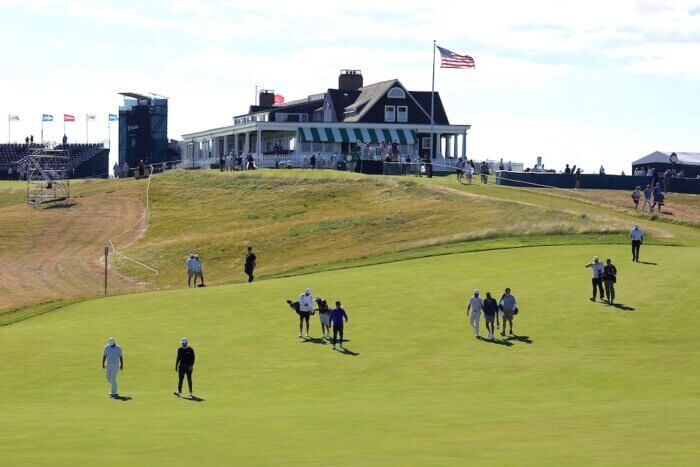
But here’s the thing, I love Shinnecock Hills in the Hamptons with its brawny, sprawling fairways, its Stanford White clubhouse perched up there on a knoll, a links that is superbly testing as well as being “blessedly treeless” as Tom Watson once described it to me.

In 1986, on the first of my four previous visits to Shinnecock for a U.S. Open, I fell in love with the Hamptons. I wasn’t so much taken by the light on this part of Long Island as was the artist Willem de Kooning, who began spending summers out here 70 years ago and subsequently described the light “as a miracle.” I was taken by Shinnecock and its surrounding area because it is perhaps the most British of all the U.S. links, with a railway line within hearing distance and adjoining a narrow road of precisely the sort one encounters in the British countryside. A four-lane highway it is not.
As if to draw this visitor from the east into its embrace and make me feel at home, that U.S. Open was marked by the sort of weather more normally associated with the Open Championship. Strong winds and slanting rain battered competitors on the opening day, prompting Frank Hannigan, then executive director of the USGA, to begin a press conference by saying: “Welcome to the first British Open to be held in the U.S.” Bob Tway’s even-par 70 was the best score of the first round.
I see some of Shinnecock’s fairways in the 16th at Royal St David’s in Harlech, Wales, in the way they fall away from the tee, rise and fall again in the mid-fairway before a bone-hard green gleams in the distance. In the second at Nefyn, the hole that skirts a bay on that glorious course on the Lleyn peninsula in North Wales, I am reminded of a clifftop hole at Pebble Beach. I think of steep-sided holes at Old Head in Ireland where you fear that a misstep or a gust of wind will send you tumbling down a cliff – as well you might on the eighth at Pebble Beach, for example.
Let me come clean about this. I think that golf courses for major championships or tournaments should be so difficult as to make the game’s most accomplished players scratch their heads and walk off with a sense of enormous relief that a stern examination is over for at least one day. “It’s a S level not an A level,” Gerald Micklem, one of the UK’s most influential and distinguished administrators in the past century, said, meaning it’s a scholarship test for the best of the best not for anyone lesser.
Unlike many U.S. Open courses that have fairways as slim as a hotel corridor, those at Shinnecock will average 48 yards in width, which is more than twice the length of a cricket pitch and nearly as long as an Olympic-size swimming pool.
Hard but fair is my motto, perhaps even very hard and very fair. It is significant that while there were howls from the pros about how difficult Aronimink was on the first two days of the recent PGA Championship, particularly the greens and pin positions, there were no suggestions that it was unfair as had been the case at Shinnecock for different reasons at the 2004 and 2018 U.S. Opens.
So a recent observation about Shinnecock was music to my ears. Golf magazine revealed recently that 624 players have competed in the past four U.S. Opens at Shinnecock and only three, repeat three, played 72 holes under par. Brooks Koepka, the winner in 2018, the most recent, was 1-over par after 72 holes. “There are just golf demons around the place,” John Bodenhamer, the USGA’s chief championships officer who sets up U.S. Open courses, said. “They come up out of these putting greens in a devilish, wonderful, charming way.”
Unlike many U.S. Open courses that have fairways as slim as a hotel corridor, those at Shinnecock will average 48 yards in width, which is more than twice the length of a cricket pitch and nearly as long as an Olympic-size swimming pool. “They are the widest we’ve seen in 50, if not 75, years,” Bodenhamer said.
“Shinnecock looks good. The fairways are very generous,” Rory McIlroy said at the recent Memorial Tournament, having scouted the course in advance. “They are more generous than in 2018. But the first cut of the rough is 5 inches long. The fairways are very, very generous so if you miss the fairway I feel like you deserve a bad lie.”
Scottie Scheffler, who also visited Shinnecock before the Memorial, added: “I was a little surprised at the width of the fairways but the green complexes there are extremely difficult and I think that’s where the greatest challenge comes from.”
Yet there is more to Shinnecock and its surroundings than just this top-notch golf course, one of many in this area. To be completely at ease at a tournament, a requirement is to be comfortable in your surroundings. And when I am staying with a long-standing and generous friend in East Hampton and he takes me to play golf at Maidstone or when I have a lesson from Eden Foster, the inestimable pro there, I feel completely at home. Life as P.G. Wodehouse might have said “is absolutely tickety boo.”
This admission stamps me as a man of the Hamptons, which is a bizarre thing to say of one born in Wales who has lived in England for almost his entire life, though he did spend an enjoyable 11 months in Manhattan many years ago. But this part of the world propels me and my imagination into the life of a sybarite and I don’t mind admitting that, if pushed, I can cope with that. I like the look of polo shirts, chinos and sunglasses and, good heavens, I have come to like the practice of not wearing socks when going out in the evening.
“If it’s set up the right way, I think it’s one of the best championship tests in the country,” McIlroy said of Shinnecock Hills. “I mean it’s an amazing golf course.” And just to gild the lily, I think it is set in a memorable part of the world. Roll on the 126th U.S. Open. I am salivating at the prospect already.