

STOWE, VERMONT | For someone who was born in Washington, D.C., raised in Greenville, South Carolina, and has residences in that city as well as the North Carolina mountain community of Cashiers, Beau Welling does not usually find himself in winter sports getaways. But the past two years have been different in that way, due to the places he sometimes goes for his work.

There were the two weeks he spent this past February in the upscale alpine village of Cortina d’Ampezzo in northern Italy in his capacity as president of World Curling, for that was where the competitions for the sport that federation oversees were staged during the 2026 Winter Olympics.
And Welling had been to that Dolomite Valley town the previous spring for the World Junior Curling Championships, primarily to see whether that venue was ready for this year’s Games.
This stretch has also seen Welling, who runs his own golf course design firm, make several trips to this Green Mountain village to renovate a charming country track at the Stowe Country Club. Routed across an old dairy farm shortly after World War II in an area where red barns and clapboard colonials rise alongside stands of maples and pines and pastures divided by dry stone walls, it had long served as a vital part of the community, which today boasts a population of roughly 5,200 people. But the club and course both needed a lot of work, which is why the owners reached out to Welling.

His assignment at Stowe began in earnest in 2024, and since that time, he and his associate Chase Webb have revamped all 18 holes of what is now a par-71 track that measures 6,420 yards from the tips and offers four sets of tees. They reconstructed and regrassed all greens and tees; reshaped, regraded and regrassed the fairways; and upgraded the bunkers.
The architects also installed modern irrigation and drainage systems that vastly improved turf conditions for a layout that features five par-5s and six 3-pars. The felling of hundreds of white pines had the same effect as they also opened up views of the course as well as the mountains that rise all around it. And Welling, who has also collaborated on occasion in the design realm with Tiger Woods, further enhanced the aesthetics by allowing swaths of field grass to grow where the trees once stood, being sure they did not impact play too much.
“The transformation of the Stowe Country Club represents a meaningful investment in both the game of golf and the future of the Stowe community,” said Sam Gaines, a Connecticut native who relocated to Vermont from New York City in 2011 to begin serving as the president of Mt. Mansfield Co., which owns the property. “This project honors the history of the course while reimagining it for the next generation, creating a place where members, guests and local residents can gather to enjoy the landscape, the sport and the shared experiences that define this region.”
Welling appreciated the sentiments that Gaines shared with the golfers who had assembled for the recent reopening.
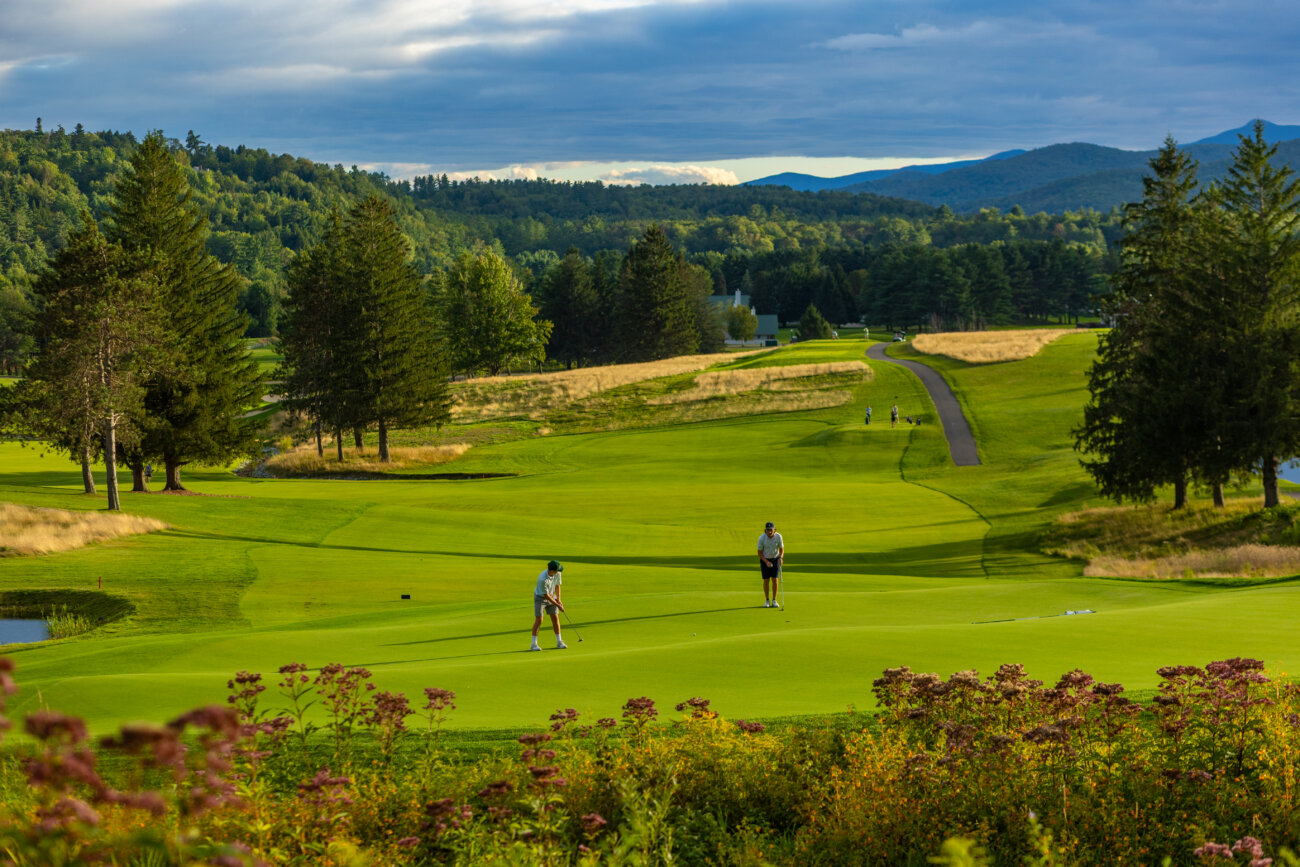
“From the outset, our goal was to create a course that feels true to its setting while enhancing the overall playing experience,” he said. “What a beautiful setting it is, and by working with the land’s natural movement and refining its existing character, we shaped a layout that offers greater variety and flexibility, making it enjoyable for players of all levels.”
A couple of years after Gaines came to live and work in Stowe, he met Welling at a gathering of the Urban Land Institute, a research and education organization founded in 1936 that focuses on real-estate development, housing and transportation.
“I’m a curious guy, Beau’s a curious guy and we struck up a pretty quick friendship,” Gaines said. “I told him about Stowe Country Club and the fact that we had to do some work on the course. And he said he would be happy to look at what we had and how we might make it better.
“We believed we had the foundation for a great, northern New England course that harkens back to the days when courses were more than just a place to tee it up but also important parts of the community. I just wasn’t sure how we did that and how we made it all work economically.”
“I was blown away by the beauty of the mountains, the views and the physical movement of the ground.” – Beau Welling
Welling was intrigued, and he fell hard for Stowe once he found his way here.
“I was blown away by the beauty of the mountains, the views and the physical movement of the ground,” Welling said. “And I liked the potential of the setting. In my mind, there are two types of mountain courses, those that are routed in a valley with hills all around them, and those built on top and on the side of mountains. I much prefer courses that are the former, and that was what Sam had at Stowe.”
Welling was struck by something else, and that was the role the Stowe Country Club played in the community, which is famous for being home to among the most challenging ski areas in New England as well as the place where members of the von Trapp family of “The Sound of Music” fame settled after fleeing Austria when Nazi Germany annexed that nation in 1938.
“I am a big fan of Alister MacKenzie, not only for his design work but also for the way he believed golf could and should serve communities, for the green spaces they provided, the recreational opportunities they offered and how they acted as important social centers,” Welling said. “And I had come to appreciate from my conversations with Sam as well as my first visit here that the Stowe Country Club had long been doing that for this town.
“It’s a really special place. And our hope is that the club and community enjoy even richer and more special experiences here in the years ahead.”
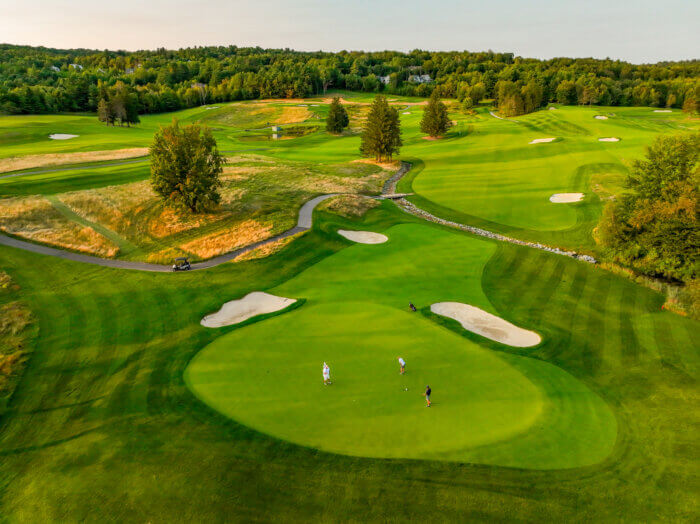
The new course officially opened on July 1, a chamber-of-commerce day with a cobalt blue sky hanging over lush green hills and a tee sheet full of golfers eager to play a full 18 holes after two years of construction limited them to repeat loops on whichever of the nines was open.
It was my first game at Stowe, so I had no real frame of reference that I could use for comparative purposes. But I did enjoy the overall experience, beginning with the scenery and setting. I especially liked looking across the course at the different groups of golfers as I admired the character of the property and the various hills and hollows it possessed. Welling gave us lots of room in the fairways for our drives, and the greens were ample as well, though I found their subtle undulations difficult to discern at times and came to regard two-putts as great accomplishments. Per usual, I missed more than my fair share of greens, but the designers always gave us reasonable ways to recover. There was good variety, too, in the types of shots I had to hit and the yardages they needed to travel. And the sand in the hazards that employed the Better Billy Bunker Method was in such good shape that I was able to make two up-and-downs during my round.
Fortunately for the purposes of this story, I did play with a member who knew the course in its previous iteration quite well and had played here the week before. And after our game, he raved about the changes.
“The conditioning is so much better,” said Aaron Geller, a 33-year-old tech industry executive from Boston who frequently travels to his second home in Stowe to ski and to tee it up. “And the new design and routing have made it a fun course, one that you can certainly play every day. It’s challenging and interesting at the same time, and I like how they can move the tee markers and hole locations around, so it plays differently round to round.”
“People are very calm and content in Vermont, very chill and fun to be with. And I have a great time when I am in town, whether I am with friends or playing with folks I have just met.” – Aaron Geller
Geller also spoke to the overall ambience of the club.
“The caliber of people here are really good,” he said. “They are very calm and content in Vermont, very chill and fun to be with. And I have a great time when I am in town, whether with friends or with folks I have just met.”
Those comments make me think of Welling and how he embraces the concepts of community in golf. And I can see the ways that those are already working here. The main practice putting green right off the terrace outside the clubhouse, with those drinking beers after their games ribbing those trying to hone their strokes before heading out for their games. And the small putting green the designer has put right next to the first tee, so golfers getting ready to tee off can chat with those preparing to do so.
“These are simply ways to get members and their guests to interact more,” Welling explained. “Same with the comfort station they have built in the style of a maple sugar shack in the middle of the course by the fourth and 14th holes. It’s another place for people to gather.”
Indeed it is, and the work Welling has done with that concept as well as the course redesign itself makes me think that he needs to keep coming back to the mountains, no matter what the season, for he is very much at home in these parts – and very good at what he does there.