Editor’s note: This story was first published in PineStraw Magazine in March 2020.
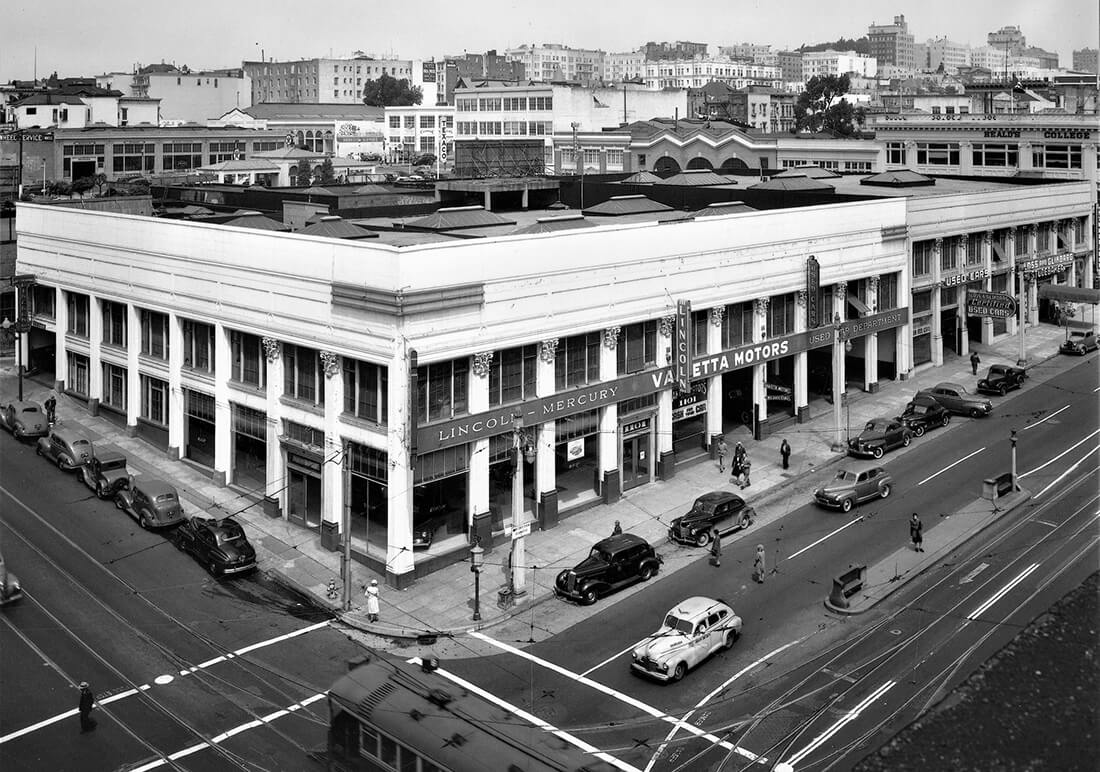
They were two good-looking guys peddling Lincolns for Van Etta Motors in San Francisco in the mid-1950s. But to label Harvie Ward and Ken Venturi car salesmen would be like saying Elvis Presley was a soldier. In 1956, Ward, age 30, and Venturi, 24, were better known as the two finest amateur golfers in America.
Like many leading amateurs of the day, Ward and Venturi were disinclined to pursue the grueling life of a touring professional. The thought of driving bone-numbing distances to far-flung tournaments playing for paltry prize money offered little attraction. Far better to enter an occasional tournament while still earning $35,000 a year at the dealership, working mornings and playing afternoon matches at California Golf Club, Cypress Point or San Francisco Golf Club. According to Venturi, “If you weren’t going to buy a car from us by noon, you weren’t going to buy a car from us that day.”
The convergence of these two stars at the dealership was no coincidence. It was engineered by Van Etta Motors’ wealthy and flamboyant owner, Eddie Lowery, a noteworthy figure in golf for nearly half a century. It was pint-sized Eddie who, at age 10, caddied 20-year-old Francis Ouimet to a playoff victory over Harry Vardon and Ted Ray in the 1913 U.S. Open at The Country Club in Brookline, Massachusetts, kick-starting America’s love affair with golf.
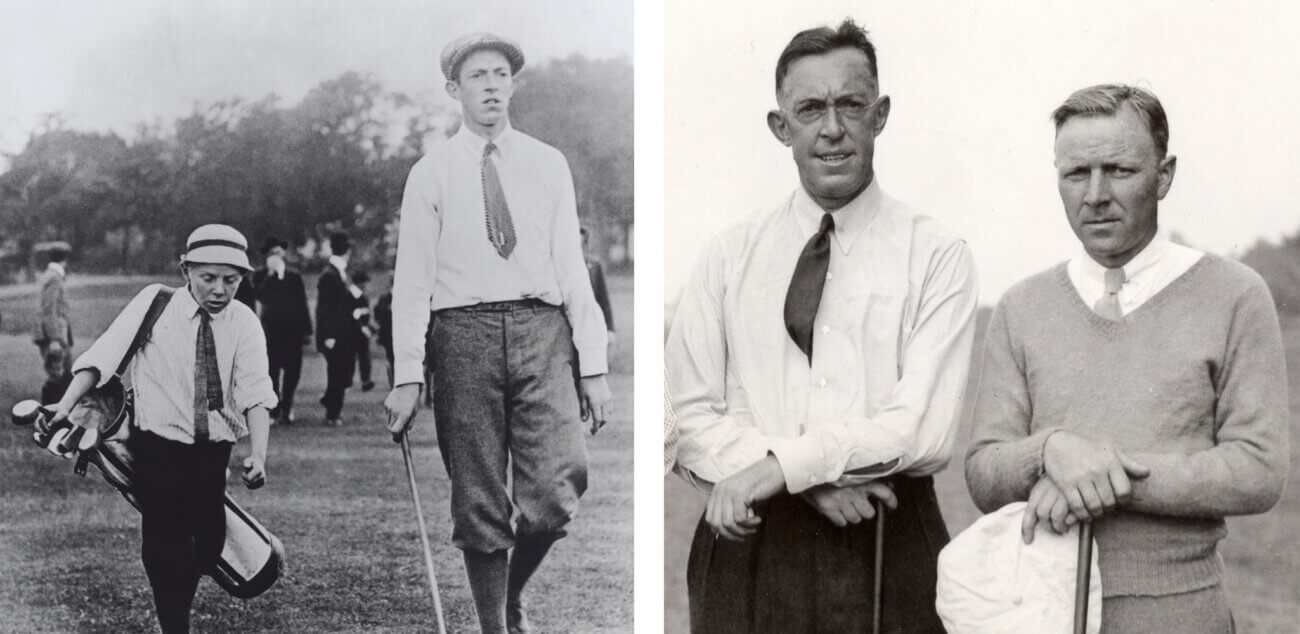
The diminutive Lowery became a fine player in his own right, capturing the 1927 Massachusetts Amateur. After moving from the right coast to the left, he partnered with Byron Nelson to win the Bing Crosby National Pro-Am in 1955. Capitalizing on his associations with Ouimet and others in the USGA hierarchy, he was appointed to various golf administrative posts, including the powerful USGA Executive Committee.
Lowery was not merely a golf Brahmin, but a business mogul, too. He built Van Etta Motors into the largest Lincoln-Mercury dealership in the country. Lowery carried a soft spot for the Bay Area’s talented young players and, in 1952, he arranged for Venturi to play with Nelson, a five-time major champion. After Venturi graduated from college in 1953, Lowery hired him to join the dealership’s sales force. Months later, figuring the presence of two star golfers working the showroom would draw car-buying sports fans in droves, Lowery enticed Ward to quit his stockbroker position in Atlanta and come west with his wife, Suzanne.
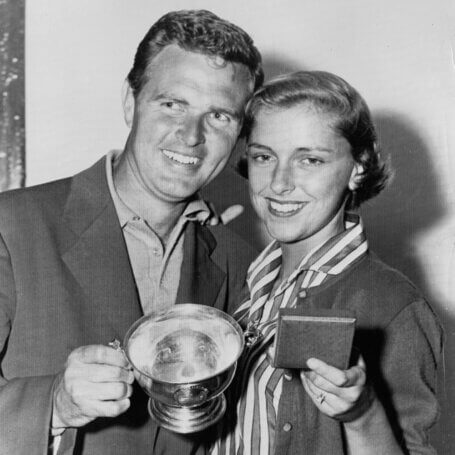
The easygoing Ward possessed salesmanship skills that would have brought success if he had never picked up a club. He seemed to like everybody, and everybody liked him – male and female. With his sweet eastern Carolina drawl, the preternaturally relaxed Harvie was the smoothest of smooth talkers, melting buyer resistance with gentle humor.
Lowery was justifiably proud of his two employees, and bragged they could beat any two players in the country – amateur or pro – in a four-ball match. His bet was called in February 1956 by oil and mining tycoon George Coleman at a Pebble Beach soiree prior to Bing Crosby’s annual “clambake.” Coleman and Lowery each ponied up $5,000. The slick oilman had persuaded a pair of Texans to oppose the two salesmen: Ben Hogan and Byron Nelson.
Arrangements were hastily made for the match to be played the following morning at Cypress Point. Ward and Venturi, both bleary-eyed, barely made it to the first tee to face their idols. The game featured a blizzard of birdies by all participants. Hogan, who purportedly muttered on the final green that he was “not about to be tied by a couple of damn amateurs,” holed his birdie putt to win the match 1 up. The Hogan-Nelson team shot a collective 57, besting Ward-Venturi by one shot. It was the only time the car guys ever lost.
Their great play in the historic encounter seemed to inspire both Ward and Venturi to greater heights in ’56. In August, Ward successfully defended the U.S. Amateur championship he had won in dominating fashion in ’55. His résumé already included the NCAA individual title in ’49 when he was an undergrad at the University of North Carolina, the British Amateur in ’52, and the Canadian Amateur in ’54. Venturi, a Bay Area product who had twice won the prestigious California State Amateur, would finish runner-up in that April’s Masters and later beat Ward, 5 and 4, in front of 10,000 spectators in the final of the San Francisco City Championship. Ward was the defending champion, having assumed the title while Venturi (who previously had won the championship twice) was away fulfilling his military obligation. When they shook hands on the first tee Venturi said, “Harvie, I’ve come to take my City back.”
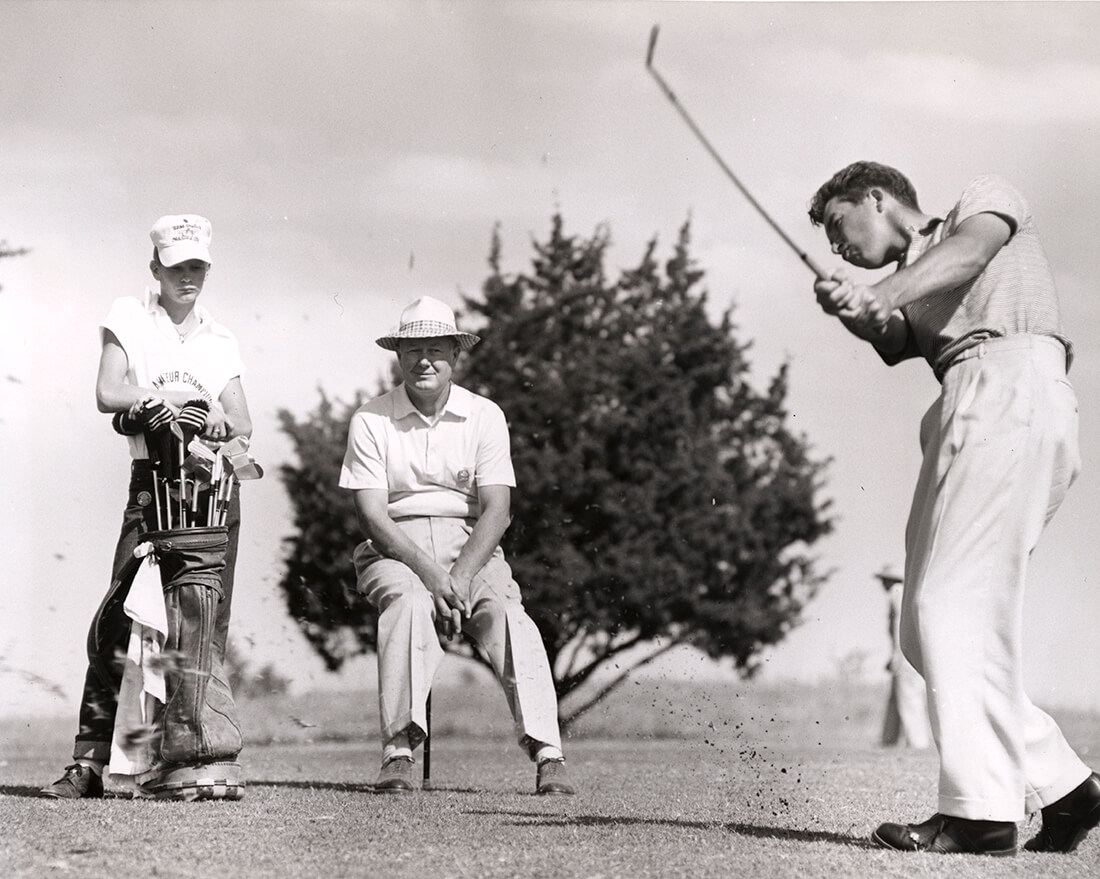
Venturi’s heartbreaking final round of 80 in the ’56 Masters dashed his golden opportunity to capture the green jacket as an amateur. He abruptly turned pro and left the dealership at the end of the ’56 season and enjoyed immediate success on the PGA Tour, winning twice in his rookie year and four more times in ’58. Adamant about retaining his own amateur status, Ward remained with Van Etta Motors and looked forward to the ’57 season, hoping to become the first player to win three consecutive U.S. Amateur championships.
But first, Ward would make his April pilgrimage to Augusta to compete in the Masters. In his initial appearance in 1948, he had conspicuously pulled onto Magnolia Lane with a string of tin cans trailing his tan Ford convertible and a painted sign on its side reading “Masters or Bust.” Despite this prankish debut, the event would come to hold special significance for Ward. During his stockbrokering days in Atlanta, Ward forged a relationship with Augusta National’s president and founder Bobby Jones, whose law firm was located in the downtown building next door to the one where Ward read the stock ticker. Ward often stopped by to talk golf with the legendary Grand Slam champion and they became good friends.
Having never turned professional during his own playing days, it was Jones’ fondest wish that an amateur might win the Masters. During the mid ’50s, among those who stood a chance were Ward (who finished eighth in 1955), Venturi, and Billy Joe Patton, another North Carolina product who narrowly missed winning in 1954. Ward later told a friend that Jones, whose debilitating spinal disease claimed his life in 1971, once intended to appoint the first of those three to win the Masters to be his successor as Augusta National’s president.
Ward had his best opportunity in the ’57 Masters. Through three rounds, he stood just one shot behind tournament leader Sam Snead, tied with Arnold Palmer. On Sunday he was paired with short game wizard Doug Ford, who went on a sensational run, vaulting to the lead. Ward was still near the lead with four holes to play. On the 15th, Ford, the former pool hustler, went for the green with his 4-wood second. The shot smashed into the bank of the fronting pond and popped onto the putting surface, leading to a momentum-shifting birdie. Meanwhile, Ward’s putter turned cold; several of his putts lipped out on the back nine, and his opportunity for a historic victory drifted away. But his fourth-place finish, behind Ford, Sam Snead and Jimmy Demaret, further cemented his standing as one of the game’s premier players.
Ward anticipated more highlight reel achievements to come. He was frequently mentioned as one of the favorites in the upcoming U.S. Open at the Inverness Club in Toledo, Ohio. He stood a good chance of being named the U.S. Walker Cup captain for the ’57 matches – a rumor that USGA president (and Pinehurst friend) Richard Tufts did nothing to dispel. And he liked his chances for a three-peat in the U.S. Amateur in August at Lowery’s old stomping ground, The Country Club.