Saturday, June 6, 2026 Pink Breast Cancer Ribbon
Back to Top

Second Wind

Just being Roger

A half century of tales from one of the game’s originals

Roger Maltbie has stories, the kind that have been told and retold over drinks and dinners, their edges still sharp, the details still clear and the beauty still in the essential truth of the story itself.

Like the story about how he won the inaugural Memorial Tournament 50 years ago when a lousy 4-iron shot caromed off a piece of rebar holding a gallery rope in place and bounced onto the green, helping him beat an angry Hale Irwin in a playoff.

Like the story about him drinking a beer one Monday morning and sticking a needle in Jack Nicklaus at one of the Golden Bear’s proudest moments.

Like the story about how he could have and maybe should have won the 1987 Masters had he only been able to shoot 36 on the second nine on Sunday.

“Who do you know who doesn’t love Roger Maltbie?”
— Jimmy Roberts

Like the story of how he was twice approached about occupying the chair alongside Jim Nantz in the 18th tower for CBS Sports and ultimately turned it down.

And, of course, the story about how he won the 1975 Pleasant Valley Classic and lost the $40,000 winner’s check a few hours later.

We’re getting to those Maltbie stories because they deserve the telling and the retelling, but they are like decorations on a Christmas tree and who doesn’t love a good Christmas tree?

“Who do you know who doesn’t love Roger Maltbie?” asked Jimmy Roberts, one of Maltbie’s longtime associates at NBC Sports.

Well, Hale Irwin for one.

That takes us back 50 years to the first Memorial Tournament played at Muirfield Village, the tournament and course created by Jack Nicklaus.

Muirfield Village is the magnum opus of Nicklaus’s extensive course-design collection and the Memorial is its elegant frame. Because of the Nicklaus name and the Augusta-like qualities built into the course, the Memorial Tournament had an instant gravitas when it debuted in 1976.

With a field full of the game’s stars, Nicklaus probably didn’t imagine the inaugural Memorial would be won by a 24-year-old, second-year pro wearing patchwork plaid pants, a dark blue shirt and a mop of brown hair long enough to cover his ears. But golf is funny that way.

At the end of 72 holes, Maltbie and Irwin were tied, forcing a playoff. Nicklaus didn’t want sudden-death so he instituted a three-hole playoff that, for whatever reason, would be played over the 15th, 16th and 17th holes.
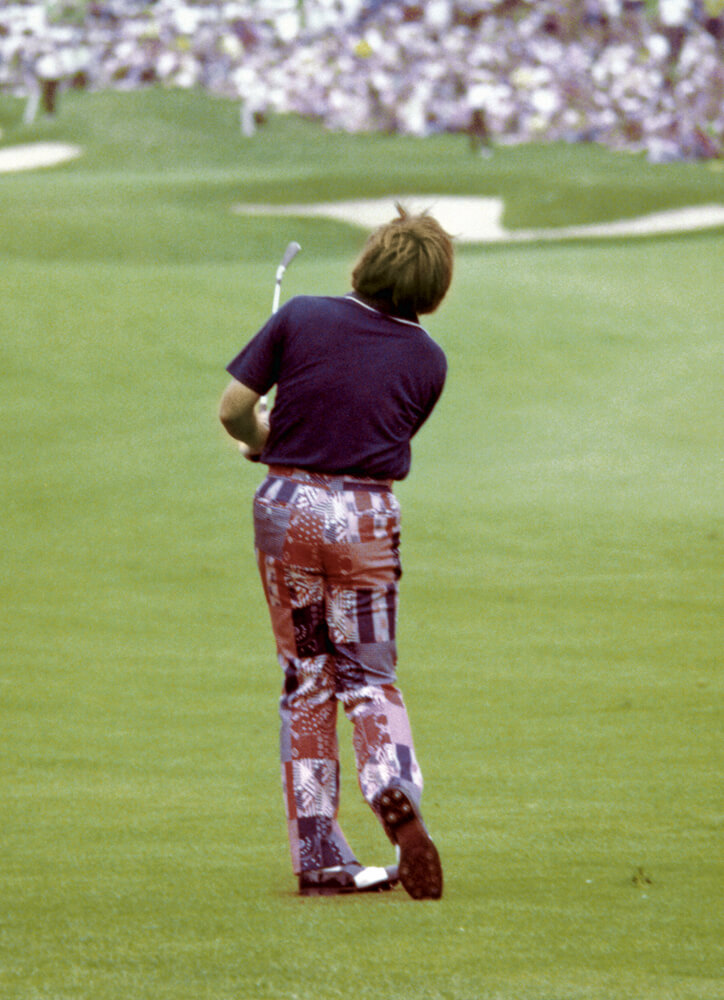
Roger Maltbie at the 1976 Memorial Courtesy the Memorial

Here’s Maltbie picking up the story from the 17th hole until the end:

“They started the playoff on 15, the five-par. Why would you start a three-hole playoff that ends on 17? It didn’t add up. Anyway, I get to the 15th tee. Hale is there waiting, and I walked on to the tee, went across and extended my hand to say good luck. What else do you do?

“My caddie, Jeff Burrell, he said loud enough for Hale to hear it and the people nearest to hear it, he goes, ‘He thinks he’s gonna win,’ which I’m sure he did. Who didn’t, maybe including me. He won the massacre at Winged Foot. I mean, come on, the guy’s a great player.

“But anyway, I laughed, and it was like all the tension left. Come on, let’s just go play. So we both birdied 15. We both parred 16. Now we’re on 17. We’re both driving near each other in the fairway. I was away. I hit 4-iron and pulled it left of the green. 

“The ball ricocheted into the center of the green. What happened? I don’t know. I think maybe I hit somebody right in the noggin, or something for that to happen, to kick out like that, because it wasn’t a good spot, left.

“I looked up, and Hale is just glaring holes through me with his eyes, not happy. He hits a beautiful shot in. He’s maybe got 10 or 12 feet right underneath the hole. I putted down and missed. I walked to the back of the green and took my glove off. My caddie says what are you doing? I said he isn’t Hale Irwin because he misses straight-in 10-footers to win, right?

“Sure enough, he missed. We got to 18 and I think I drove it within two yards of where I had driven it on the 72nd hole. I knew the club. I hit a 4-iron again. It was virtually an identical shot. The same place behind the hole. I knew how it broke.

“He drove it to the right and there were these big trees at the dogleg. He got it locked up over there. It wasn’t a terrible tee shot, but it ended up in a bad spot. Well, now you can’t get it on the green, and he’s chopping it around … and I made the putt to win.

“The media room is in a cart barn. I go in and they’re interviewing Hale. He’s not pleased. That’s obvious. I’m sitting in the back row waiting my turn. The doors open and a marshal comes in with a piece of rebar that my ball hit and says, ‘I thought you might like to have this.’ Why would you do that? So I’m sitting there saying, thank you, that’s very kind. I look back up at Hale. Sheepishly I go [raises the bar toward Irwin] and he says, ‘No, thanks. I’ve already had the shaft once today.’

“He did not speak to me for about six months.”

Longtime NBC Sports colleagues Roger Maltbie and Gary Koch have been friends since the 1970s.

Maltbie grew up in San Jose, California, where he attended high school, San Jose City College and, finally, San Jose State University. He is California through and through, still living in Los Gatos, 10 miles southwest of San Jose.

He played most of his amateur golf in California, building a solid local reputation but unlike so many young players today, he didn’t play a national schedule because it was expensive. Maltbie never tried to qualify for the U.S. Amateur.

“He came on tour, not many people knew him. He really never played outside California growing up, even in college. He didn’t have any kind of national reputation,” said Gary Koch, who met Maltbie in the 1970s and has worked with him for close to three decades at NBC Sports and Golf Channel.

“Once he got on tour, you could tell. He was a really good ball striker with the old equipment. There weren’t many who hit the middle of the clubface all the time.”

Beyond the golf course, Maltbie was an American original. Golf was a job but Maltbie has always embraced life on his own terms, sometimes with a cocktail in his hand and a twinkle in his eye.

“I’m reminded of what Oscar Wilde said, ‘Be yourself; Everyone else is already taken.’ That’s who Roger is,” Roberts said. “He’s one of a kind and without any effort.”

Which brings us to the 1977 Memorial Tournament when Nicklaus won on a Monday morning after rain pushed the finish to an extra day. Maltbie was on the 18th hole when play was suspended on Sunday evening, forcing him to stay over.

Maltbie had hit his final tee shot before play was stopped so he sent his caddie and his nearly full golf bag on to Charlotte for the next tournament, keeping a couple of irons, a sand wedge and a putter. When he finished that Monday morning, Maltbie watched the tournament conclude from the clubhouse. He relates the tale:

“I went to the grill room over the pro shop. I had a beer after finishing a round of  golf. I was on a balcony having a cigarette. Jack is walking toward the clubhouse.

“He’s surrounded by people, signing autographs. He happened to look up and I said, ‘I never thought this tournament would have a fluke winner.’”

Roger Maltbie rues letting the 1987 Masters slip through his fingers.

Before Maltbie became one of the voices of golf in American audiences’ ears, he was a top-tier player, winning five times on the PGA Tour and 12 times overall, including three Liberty Mutual Legends of Golf titles with Koch.

He crashed the scene in 1975 when he won the Ed McMahon-Jaycees Quad Cities Open and the Pleasant Valley Classic in consecutive weeks. We’ll get to the story about the winner’s check at Pleasant Valley shortly.

Maltbie won the Memorial in ’76 and had a big year in 1985 when he won the Manufacturers Hanover Westchester Classic and the NEC World Series of Golf, the latter when he shot 12-under par at Firestone Country Club.

“He was a natural.”
— Dan Hicks

The one that got away came at the 1987 Masters.

Maltbie was in the final pairing with Ben Crenshaw on Sunday after rocketing into contention with a second-round 66 on a windy Friday. A solid 70 on Saturday playing with Curtis Strange put him at 4-under par, tied with Crenshaw, one ahead of Bernhard Langer and Greg Norman and two ahead of a group that included Seve Ballesteros.

On the 10th tee in the final round, Maltbie led by one stroke.

A few years back, Maltbie and Dan Hicks, his longtime NBC colleague, were walking to breakfast at Augusta National, having spent the night in a club cabin.

“As we crossed the 10th tee, Rog shuddered a little bit as if some sort of cold air blew over him,” Hicks said. “I go, ‘You OK?’ He said, ‘Every time I come across this tee I think about how I had the lead on the second nine on Sunday.’

“It was an example of how good he really was and how talented. He was a natural.”

And he almost won a green jacket.

Roger Maltbie on the 13th hole during the 1987 Masters Augusta National, Getty Images

“You’ve watched the Masters every year since you’re just a tiny little kid and you know the tournament doesn’t start until the second nine on Sunday. Well, I will admit there wasn’t a lot of oxygen.

“I bogeyed 10 and 11. I put it in the front bunker at 12 and got it up and in. Then I didn’t birdie 13. On 14, the hole was cut on the upper tier right before they changed the green. The ball just skipped over, but I hit it right at it anyway, skipped over. I’ve got a 5-footer [for par] and I miss that and now I’m falling behind.

“To get that close to it and not get it, it hurt.”
— Roger Maltbie

“I wouldn’t say I was despondent but I understood. I didn’t birdie 15. I parred 16. Then I birdied 17 so I’m one shot back going to 18. [Larry] Mize has already posted.

“I drove her right in the heart of the fairway. I had a 6-iron in and the hole is on the front left where it always is. With the firmness of the greens, I was trying to hit behind the hole, have it catch that slope and come down and have some kind of putt to tie.

“I throw [the approach shot] up on the right and I’m waiting for the reaction. I am probably more proud of that swing than any swing I ever made. It’s just right of the hole and if it comes down, it’s going to get somewhere around the hole. And the crowd just kind of [murmurs]. I knew what had happened. It hit and just bounced on top of that [green].

“There’s another problem with having watched every year since you were a kid –  you know nobody has ever made this putt.

“If I had shot 36 on the back nine, I’m wearing a green jacket. That’s all I had to do. I’m not saying it was easy. No, but that’s all I had to do. I didn’t have to do anything miraculous. To get that close to it and not get it, it hurt.”

Roger Maltbie calls 'em like he sees 'em at the 2007 Honda Classic.

Six months after his Masters disappointment, Maltbie was playing the Pensacola Open when he hurt his left shoulder hitting a shot from clumpy, thick Bermuda grass.

The injury would lead to the first of two shoulder surgeries. While dealing with the aftereffects of the first surgery, Maltbie was invited by NBC to work the unofficial event at Kapalua in Hawaii, all expenses paid.

He was good enough that NBC called a few weeks later and offered him a job, paying $3,000 a week. Maltbie declined and kept trying to play but after a second shoulder surgery in late 1989, he couldn’t hit the shots he needed to hit.

“This guy sounds like he’s been doing it for years. He had the gift.”
— Dan Hicks

When NBC called again, Maltbie said yes. His first tournament was the 1991 Bob Hope Chrysler Classic in Palm Springs and Maltbie was sent to Bermuda Dunes where the leader, Mark O’Meara, was playing.

Promised a rehearsal before he went on air that Saturday, Maltbie’s equipment malfunctioned and he went on cold.

Hicks was working at CNN at the time and remembers hearing Maltbie working that Bob Hope event.

“This guy sounds like he’s been doing it for years. He had the gift,” Hicks said.

Years later, Hicks would be doing his prep work before a telecast and Maltbie would be relaxing.

“I would ask him, what are you doing? He’d say, ‘Danny, I report what I see,’” Hicks said

“It was the quintessential Roger line. ‘I report what I see.’ So simple and so right … Rog used to say, ‘Sometimes guys it’s wind out of the left, 5-iron, that’s all you need to say.’”

Thirty-five years into his second career, Maltbie remembers that first full weekend in the southern California desert.

Roger Maltbie (second from left) relaxes with his fellow NBC Sports announcers (from left) Dottie Pepper, Jimmy Roberts, Mark Rolfing, and Gary Koch in media production studios before going on air for the third round of the U.S. Open at Torrey Pines in 2008. Simon Bruty, Sports Illustrated via Getty Images

“I’ve got no idea what I’m doing, none. They’re using TV terms. I don’t even know what they’re saying. I drive back to Indian Wells, I get back there, and there’s nobody around, and I catch [producer Larry] Cirillo going to his car.        

“I said, whoa, whoa, Larry, you got to help me. He told me the best thing that was ever told to me about doing television. He said, just be yourself. You know the subject matter. Just be Roger. OK.        

“When I watch CBS and those guys doing golf, it’s the ones that sound like themselves that I think are the best guys. They’re not trying to be announcers. They’re just being a guy, you know? I think they become more believable. You can’t see them but you’re talking to people.”

Just be Roger. It is not the only reason for his enduring success and popularity but it is a substantial part of why Maltbie has become part of the game’s fabric.

He’s not often on camera but the image comes quickly – Maltbie standing beside a green, arms crossed, microphone in one hand, white hat on his head with an earpiece strapped across the top.

“He’s always come across as kind of an everyman, loving to have a beer. He never seemed to take himself too seriously. That endears people to him.”
— Gary Koch

When Maltbie speaks, it’s laced with insight, experience and a touch of humor.

“He’s able to sum up a situation or paint a picture in very few words. He’s always come across as kind of an everyman, loving to have a beer. He never seemed to take himself too seriously. That endears people to him,” Koch said.

It’s what led CBS Sports to reach out many years ago to again ask Maltbie if he would like to become the lead analyst for their golf coverage.

The first overture had come from legendary golf producer Frank Chirkinian, who reached out to Maltbie in the 1990s after Ken Venturi indicated his wife was ailing and he was approaching retirement age. Maltbie was three tournaments into a three-year deal with NBC and needed permission from the network to talk with CBS.

That permission was denied.

Several years later, Chirkinian again asked Maltbie if he had any interest in joining CBS. Venturi was still working but his retirement was imminent. Maltbie’s NBC contract was nearing its end, giving him room to move. But he never did.

“I didn’t want to do it behind NBC’s back so I told Dick Ebersol, I said my contract’s coming up and CBS is interested in me and I’m going to be talking to them. NBC was in negotiations to get the USGA package and Dick is a great man. I love him. He came back and said if we get the USGA package, I can compensate you in a whole different fashion.

“He said just give me a couple of weeks. Sure enough, we got the package. He contacts me and says, all I ask if you decide to leave is to give me a little notice so I can replace you.        

“CBS was doing like eight more tournaments than we were at the time. Frankly, NBC was going to pay me better even than the bigger role at CBS and that was two more months away from home.        

“Sometimes you’ve got to check your ego at the door. I’m a dad. I can’t do this. It just doesn’t make sense so I stayed with NBC. It turned out pretty good.”

Roger Maltbie and Jimmy Roberts have shared many dinners on the road through the years.

For years, Maltbie, Roberts and Hicks were regular dinner companions. It’s what happens when working with the same group of people, developing relationships and having shared interests.

It may be a different tournament and a different city but there are ties that bind. They called themselves the supper club.

And if you’re picking a dinner companion, Maltbie is on the short list. Always has been.

“I like to joke I had more dinners with Roger and Dan than with my wife,” Roberts said. “If I got there first, I knew what drink to order for them. Ketel One with blue cheese olives for Roger.”

Maltbie enjoys a cocktail and, in his own words, has never shied away from having a good time. But sometimes reputation exceeds reality.

There was, however, that weekend when Maltbie won the 1975 Pleasant Valley Classic in Massachusetts. Maltbie was on a tear and it was his second consecutive victory, having made the cut on the number on Friday.

By late Sunday afternoon, Maltbie was accepting the $40,000 winner’s check from Cuz Mingolla, who had established Pleasant Valley Country Club. It wasn’t one of those cardboard checks made for photographs. It was a regular-sized check with Maltbie’s name written in ink beside ‘Pay to the order of.’

The story has been told many times over the years but here’s Maltbie’s version:

“Cuz just hands me the real check. You fold it up and put it in your pocket. I’ve just lived two weeks beyond my wildest dreams and I am all of 24 years old. I’m the richest guy in the whole world. I had won $15,000 at Quad Cities and $40,000 at PV.

“A guy had driven me in the courtesy car during the week and he congratulated me. I said where do we go? We’ve got to celebrate. He took me to T.O. Flynn’s in Worcester, Massachusetts.

“A real life lesson was learned that evening that it’s a far different thing to fall asleep and wake up than to pass out and come to, which was my state.

“I sat on the edge of the bed. It was like an eternity before I remembered I won the last two tournaments. I was going downstairs and get a newspaper to read about how cool I was. I reached into my pants. I didn’t have a dollar, a check, a dime. I had nothing. I didn’t even have a credit card.

“I knew I had $600 in my pocket as I played the last round. It’s all gone. There’s no check, no nothing. I get the phone book out and call over [to T.O. Flynn’s]. I get somebody in there and I asked if an article had been found the night before. The person says let me look in lost and found. He says I don’t see anything.

“I guess he could detect a bit of panic in my voice. He said what kind of  check is it. I said one for $40,000.

“I get Cuz on the phone and tell him I’ve got a problem. I lost the winner’s check last night. He laughed for about five minutes then said it was no problem, he’ll void it and issue a new one.

“Not long after that, the phone rings and it’s the owner of T.O. Flynn’s who found the check. I said that’s nice but it has been voided. I don’t need it. He said do you mind if we keep it and put it behind the bar for lore?

“Then it dawned on me I had no cash. I called Cuz back and said can you send me a thousand in cash and make the check for $39,000? That’s what he did.

Roger Maltbie is working nine events for Golf Channel and NBC this year, including the AT&T Pebble Beach Pro-Am in February. Tracy Wilcox, PGA TOUR via Getty Images

“Hubert Green came up to me a few weeks later and said ‘You’re doing a really nice job with your image.’ What?

“He said losing that check was great for your image. I said all I did was get drunk and do something stupid.”

There is a sweet postscript to the lost check story. Ten years ago, when Maltbie was working the Deutsche Bank Championship outside Boston for NBC, golf writer Jason Sobel hunted down the famous check.

It was in the desk drawer of Paul Parajeckas, the head pro at Pleasant Valley. When Sobel asked if he could give the check to Maltbie, Parajeckas handed it over. Forty-one years later, Maltbie slipped it back into his pocket again.

After Maltbie’s NBC contract was not renewed following the 2022 season, fans complained – loudly. Along with Koch, Maltbie was brought back and this year he is working nine events for Golf Channel and NBC, including the Players Championship, the U.S. Open and the U.S. Senior Open.

As he walks the fairways now with his headset on, fans routinely call out to him. If he’s not on the air, he often makes conversation with the fans watching along with him.

He’s 74 years old and when he’s home, he plays maybe 10 rounds of golf a year. He spends time with his wife, Donna, stays connected to his two sons, pays close attention to the San Francisco 49ers and enjoys his days. Not everyone thought he would make it this far.

“I’m going to be 75. A lot of people would have probably taken the under. I think I’m going to make it.

“As I get to this age, I look at myself and say I’m still working, I get around, I still think I have my faculties. I’m doing pretty good.

“Then I go through the checklist two shoulder surgeries on my left shoulder, a knee replaced, the other on the way, stenosis in my lower back causes some neuropathy, torn rotator cuff on my right side, and a degenerative disk in my upper back. When I look at it that way, I think Jesus Christ, you’re falling apart.

“When I play and I don’t do it very well, I’m pretty much a chopper, it hurts then and it hurts later. Why do that? If I never play another round of golf I wasn’t cheated.

“People ask do I miss it? I miss how I used to do it.”

Just being Roger.

Top: Roger Maltbie calls the action at the 2025 U.S. Senior Open. Andrew Wevers, Getty Images
Other photos: 1987 Masters, Augusta National/Getty Images; 2008 NBC golf crew: Simon Bruty, Sports Illustrated via Getty Images; Roger Maltbie and Gary Koch, Hunter Martin, Getty Images; 2007 Honda Invitational, Stan Badz, PGA Tour; Roger Maltbie and Jimmy Roberts, Stan Badz, PGA Tour.
© 2026 Global Golf Post LLC