

The idea was so audacious that even the LPGA commissioner passed on it. Fortunately for women’s golf, Karsten Solheim, the visionary behind Ping golf equipment, and his wife, Louise, the business-side brains of the family-owned company, believed that a Ryder Cup-style team match between the United States and Europe would be good for the women’s game and for their company. And the Solheims had a special knack for turning visions into reality.
Thus came to be the Solheim Cup, which this week at Bernardus Golf in North Brabant, Netherlands, will be staged for the 20th time.
From a chaotic beginning in 1990, the Solheim Cup grew into an institution and carved out a rock-solid place as one of the most compelling events in team golf. There were plenty of bumps and bruises – and doubts – along the way but, as with his club designs, Karsten Solheim proved to be a man who could look into the future and figure out how to get there.
The road to making the Solheim Cup what it is today winds its way through a maze of scintillating stories involving a mad scramble to stage the first competition, compelling comebacks, a punching bag, a controversial re-chip, a move to the European continent, a shocking gimme that wasn’t and perhaps the greatest finish ever in any team golf event.
Going into this year’s competition, the record stands at 11 victories for the United States, seven for Europe and one tie. But since 2011 – when Europe took 3½ of the final 4 points to end a three-match U.S. winning streak and put to rest forever talk of expanding Team Europe to include Asia – the record is four victories for Europe, three for the United States and a tie in 2023 that resulted in Europe keeping the cup.
“It’s hard to believe that initial conversation took place more than 35 years ago and now we are approaching the 20th edition of the Solheim Cup.” — John Solheim
So how did we get from the first Solheim Cup at Lake Nona Golf & Country Club in Orlando, Florida, in November 1990 to the Netherlands?
Joe Flanagan, executive director of what was then the Women Professional Golfers’ European Tour, now the Ladies European Tour, pitched the idea of a team competition to LPGA commissioner John Laupheimer in 1988. But Laupheimer thought the competition would be too one-sided in favor of the Americans and rejected it.
“My legacy will be that I’m the commissioner who passed on the Solheim Cup,” Laupheimer told me with a laugh over dinner at the Links Club in New York City shortly before he died in 2005.
When Laupheimer resigned and Bill Blue took over on Dec. 1, 1988, Flanagan revisited the idea, and it was presented to Karsten and Louise Solheim at the PGA Merchandise Show in Orlando in January 1990.
“Your memory is correct,” John Solheim, who took over when his father died in February 2000 and is chairman of Ping, told me about the roles of Flanagan and Laupheimer. “There was some discussion about what the format would be but Joe Flanagan and I both insisted it be modeled after the Ryder Cup. Joe was very helpful and played a big role in getting the event off the ground.”
Beyond format, there was also a discussion about the length of the initial Ping contract for the Solheim Cup.
“The first proposal was for a two-event commitment, one in the U.S. and one in Europe,” Solheim said. “I quickly pulled Karsten aside for a private discussion and Louise joined us. I said two events was not enough and that they’d likely sell it to someone else after that. That’s when Louise said 10 events and 20 years. I was a little surprised but Mom was the business side of Ping, so she was comfortable making a long-term commitment.”
The players were brought into the loop at a meeting that March, and on June 7, the Solheims and their public relations director Bob Cantin, who would become Solheim Cup project director, met with Blue in the Delta Crown Room at Phoenix’s Sky Harbor Airport to sign the initial papers.
“It’s hard to believe that initial conversation took place more than 35 years ago and now we are approaching the 20th edition of the Solheim Cup,” Solheim said.
John Solheim worked with LPGA business manager Gregg Shimanski to tie down the final wording. All parties met at the JAL Big Apple Classic outside New York City in August and final papers were signed Sept. 19, less than a month after Blue was fired and less than two months before the event was to be played. Acting executive director Jim Webb signed for the LPGA.
“There were about three sad souls who had been given a ticket and they had absolutely nothing to do.” –Helen Alfredsson
“We basically staged the event with 60 days of planning,” said Cantin, who is now retired in Texas.
“I didn’t know anything about it until Blue and Shimanski called us all into the conference room to tell us we were doing this with only a few months to coordinate it,” said Tina Barnes-Budd, who was LPGA promotions manager at the time. “The way Bill Blue told the story, it was Louise who truly convinced him and got it across the finish line. She was always the biggest champion of the event.”
To say the first Solheim Cup was thrown together on the fly is almost an understatement.
“We got to the first tee about eight minutes before they were due to tee off, judging by the clubhouse clock,” said Mickey Walker, who was captain of the first four European teams. “The clubhouse clock was actually fast so we had 12 minutes, and those 12 minutes seemed like an hour. I can remember that being an eternity.”
As metaphors go, an untimely timepiece is rather appropriate for the debut Solheim Cup. When Laura Davies hit the first drive of the competition in her alternate-shot match with Alison Nicholas against Pat Bradley and Nancy Lopez, there was no TV coverage, virtually no spectators, not even an LPGA commissioner. Ultimately, the competition also lacked drama as the Americans easily dismissed the Europeans. Only one of the 16 matches made it to the 18th hole.
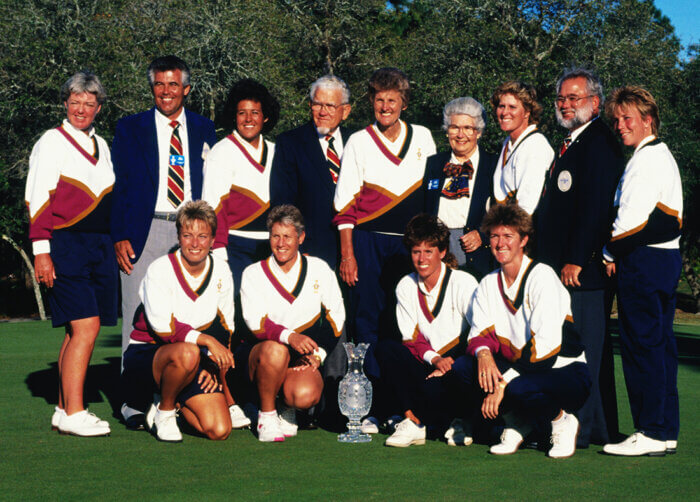
Fewer than 3,000 people were on hand for the three days of competition that week before Thanksgiving in Orlando when the most spectacular occurrence, which drew far larger crowds, was a Space Shuttle launch at nearby Cape Canaveral on the eve of the first day of play.
“I don’t recall having any doubt about pulling it off because we had nothing to compare it to,” said Barnes-Budd. “Yes, there was the Ryder Cup, but that would be comparing apples to oranges. We all had the ‘we will make it happen’ attitude. I remember standing on the first tee with co-workers and beaming with pride. That first tee shot launched a truly special event. In my mind, I felt total satisfaction. Could things have been coordinated better? Yes. Could we have actually had red, white and blue uniforms? Yes. Could we have had larger galleries? Yes. But for the amount of time we had to pull it together and for what we had to work with, I was totally satisfied.”
Initially, the apprehensions of Laupheimer appeared to be spot on. The United States dominated at Lake Nona, winning 11½-4½. The eight-woman American team, captained by golf’s greatest winner – Kathy Whitworth – included five players who would later be in the World Golf Hall of Fame: Pat Bradley, Beth Daniel, Betsy King, Nancy Lopez and Patty Sheehan, as well as Cathy Gerring, Rosie Jones and Dottie Mochrie (later Dottie Pepper).
“I knew from that very first event at Lake Nona that we had something special,” John Solheim said. “On paper, it didn’t look close with the Hall of Fame-caliber Americans versus a lot of Europeans few people were familiar with. The Americans simply out-putted Europe. That’s the beauty of match play.”
Team Europe had only one future Hall of Fame member, Dame Laura Davies. She was joined by fellow Englishwomen Trish Johnson and Alison Nicholas, Swedes Helen Alfredsson and Liselotte Neumann, Scots Dale Reid and Pam Wright and Marie-Laure de Lorenzi of France.
The only TV exposure the Solheim Cup received in 1990 was a half-hour highlight show. Remember, this was five years before Golf Channel existed. The galleries at Lake Nona were equally unremarkable.
“There were about three sad souls who had been given a ticket and they had absolutely nothing to do,” remembered Alfredsson, who played in the Solheim Cup eight times and was captain in 2007.
“They missed the afternoon movies,” Alfie added, flashing her usual sharp humor.