Catherine Lacoste, the daughter of tennis great René Lacoste, winner of two Wimbledon championships and two U.S. Opens besides being the founder of the famous Lacoste apparel brand, has done more than you would believe possible in her first 80 years. Typically, she has things arranged for as far ahead as 2031.
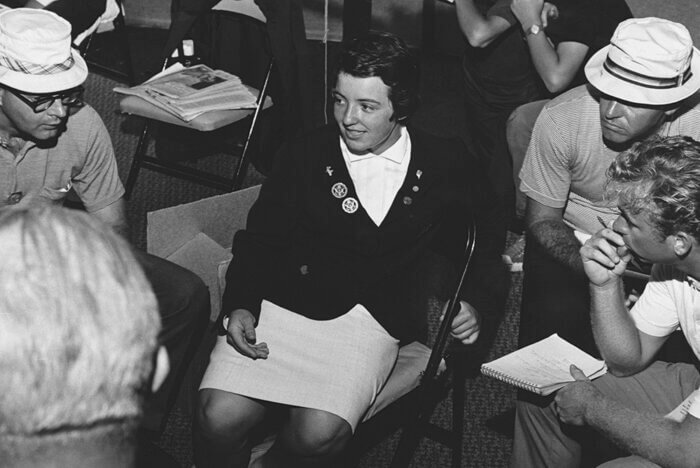
In 1967, as a 22-year-old amateur, Lacoste came from nowhere to defeat the best of the LPGA’s women professionals and make off with the U.S. Women’s Open trophy at The Homestead in Virginia. That done, she spent 1968 and ’69 winning the French, Spanish, British and U.S. women’s amateurs before retiring from tournament golf, save for occasional appearances close to home. She had woken up one morning and asked herself, “What more am I meant to do?”
Roughly the equivalent of “Been there, done that.”
Her next moves were to get married, have four children and lay down her clubs in favour of a guitar.
That Catherine has always said what she thinks and done things her way might not necessarily have met with all-round approval. But to her friends, she has always come across as friendly, funny and the opposite of boastful.
As for her fame, who will ever forget that line she delivered on the day after her U.S. Women’s Open victory. “Finally, I am someone myself, not just the daughter of the Lacostes.”
1967 U.S. Women's Open champion Catherine Lacoste
It was shortly before midnight on July 2, 1967, and René Lacoste was fast asleep in the family’s Paris apartment when the phone rang. It was Catherine on the line from Virginia and she had rung to wish him a happy 63rd birthday.
A few seconds later, she switched from that birthday greeting to an excitable, “Papa, I’ve just won!”
There was no irritated retort of “Won what, for heaven’s sake?” for her father, one of his country’s “Four Musketeers,” had had an inkling that Catherine might do the impossible in winning the championship. “To be honest, I think he was the only person who thought I might win,” Catherine said in one of the chats we have enjoyed since junior days when she would be the No. 1 on a team and I might have been asked to make up numbers.
For the most part, the women professionals were cross to the core. “Catherine had ruined their best marketing ploy, their status as the greatest women golfers in the world,” Rhonda Glenn would later write in “The Illustrated History of Women’s Golf.”
So much more information came tumbling out of Catherine that night. Not only had she been the youngest player in the field but she was the first amateur ever to outdo the regulars at the U.S. Women’s Open, and remains the only amateur to win the championship. On top of that, there was the drama attached to her final round.
She had been five ahead at the start and promptly upped that to seven when Australia’s Margie Masters double-bogeyed the first.
“At that point,” said Susie Berning, the eventual World Golf Hall of Famer who was playing in the penultimate group, “Catherine’s victory seemed inevitable, even to the staunchest doubters.” (The doubters who Berning had in mind were the professionals who throughout the week had taken it for granted that one of them would win because one of them always did.)
But all of a sudden, everything changed as six Lacoste bogeys crashed into the picture in the space of seven holes. “I wouldn’t be human if I told you I wasn’t nervous,” she admitted.
The legendary Louise Suggs, then 43, was on the attack and, after 15 holes, she was only a stroke behind.
On to the par-5 16th, the Hemlocks. The portents were not good in that Socrates died from drinking the stuff. Suggs hit into a water hazard, Berning shuffled a wedge, and Lacoste hit a shank.
Lacoste, who was lucky enough to get away with her bogey, remained in the lead, one ahead of Berning with another American, Beth Stone, one further back.
“I don’t know whether it was my character, my swing or my background,” Catherine told Sports Illustrated’s Mark Mulvoy in what was an unexpected litany of possibilities, “but I managed to hit a very good drive on the par-4 17th.”
When a 2-wood and an 8-iron left her with a 5-foot putt, her ball was as jumpy as she was herself, leaping in the air before disappearing down under.
A straightforward par at the 18th was enough to see the French player win by two strokes from Berning and Stone with scores of 71, 70, 74 and 79. No-one would have said that she played well on the last day but, as Berning said, “Under the extreme pressure of the final round – and history – she had played well enough to win.”
For the most part, the women professionals were cross to the core. “Catherine had ruined their best marketing ploy, their status as the greatest women golfers in the world,” Rhonda Glenn would later write in “The Illustrated History of Women’s Golf.”
Catherine Lacote with reporters after winning the 1967 U.S. Women’s Open USGA Museum
Berning, who won the following year’s U.S. Women’s Open and two more besides, could not have made a better job of explaining the relationship, or lack thereof, between the professionals and Catherine: “It wasn’t the fact that she was young, or a foreigner, but that she was an amateur. … Amateurs just didn’t beat professionals, or so we all believed.”
Rumour had it that on the Sunday evening, the most downcast of their number threw their own Lacoste shirts – everyone had one in those days – onto the fire at an evening barbeque. Some found it funny, others not so much.
“People instinctively dislike someone who is successful and that’s how it was with Catherine,” said Vivien Saunders, winner of the 1977 Women’s British Open. “I can promise you that it was never down to anything more than jealousy – and I can’t stress that enough.”
So what was it like for Catherine to be the daughter of the celebrated Lacostes?
“I was lucky to be their daughter,” she began. “They were wonderful parents. As well as being a great golfer, my mother, Simone de la Chaume as she was known before she married my father, was very genteel, very British. Everyone loved her.
“As for my father, he knew as much about the technique of golf as he did about tennis. In tennis, he would make notes on the people he watched and, when it came to golf, he would read Ben Hogan books …
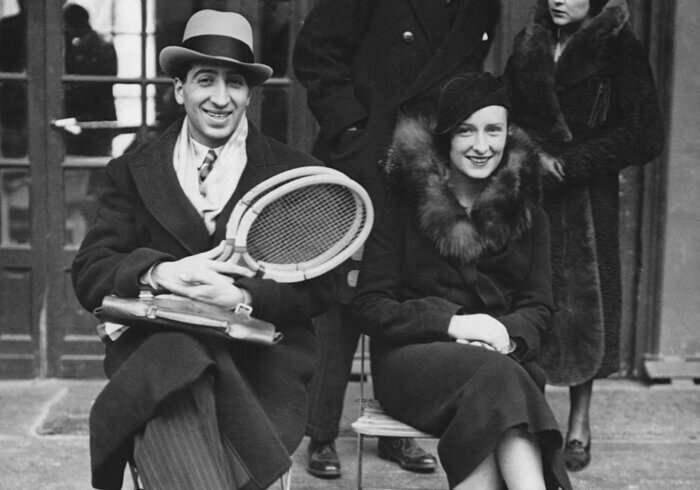
René Lacoste and Simone Thion de la Chaume, 1932 USGA Museum
“I thought he was a great golfer when I was a little girl,” she said. “Well, he wasn’t that, but he enjoyed playing with his friends and he would pass on constructive remarks about my swing via my coach, Raymond Gariälde. He never wanted to complicate things.”
To be sure, her swing had its idiosyncrasies, with Saunders and another well-known English player, Dinah Oxley, marvelling at the way she would have two feet pretty much up in the air at impact. “Dinah and I would spend hours trying to copy her and we never could,” said Saunders. Meanwhile, Cécilia Morgue D’Algue, who played alongside Catherine in a variety of leading junior and amateur events, would compare her swing to Jack Nicklaus’. “Even with her 2-iron, she hit a high ball and carried it a long way …
“There was something else that she did differently from the rest of her European rivals,” added Morgue D’Algue. “As happens with the professionals of today, she used to go to tournaments a week early.”
Catherine with her father René Lacoste Courtesy Catherine Lacoste
René was also very clever with his hands. Apart from capturing his daughter’s swing in a sculpture, he made the first metal tennis racket – a T2000 Jimmy Connors used for most of his 109 career victories. “When Jimmy was given a contract with some other company,” said Catherine, “he would keep ringing home and saying, ‘I want to play again with your T2000 rackets even without a contract.’”
Seve Ballesteros, when he was young, experimented with a Lacoste-constructed polyurethane golf club, as did Nick Faldo and José María Olazábal. Meantime, on the fashion front, Lacoste designed tennis tops with longer short sleeves and, of course, those crocodile logos. Rene had been nicknamed “The Crocodile” because he never let go of his prey, and it was with his nickname in mind that he drew a little killer of a croc for his clothes. Millions of his shirts are sold every year.
Catherine would practise alongside Seve, who was 11 years the younger and lived not far from Chantaco Golf Club, the Basque country course designed by Harry Colt and, since 1928, had belonged to her grandfather.
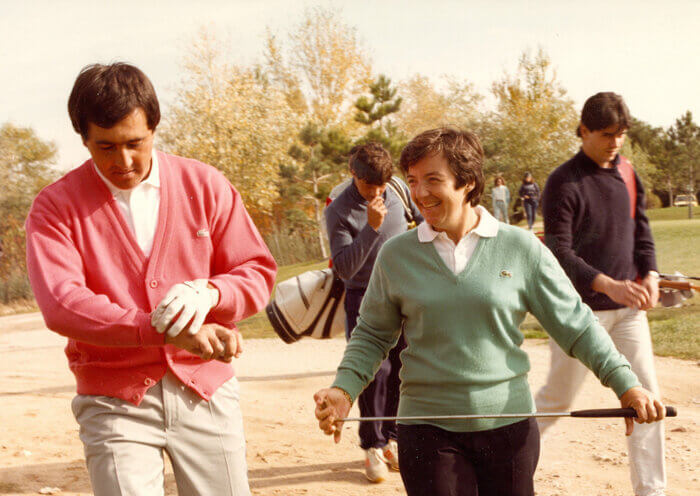
Seve Ballasteros and Catherine Lacoste Courtesy Catherine Lacoste
Seve would help her with her bunker play and Catherine, who had been given a Golden Goose putter when she was 13 and stayed with it all her golfing days, would help him with his putting. “I’m not good enough to help you,” she would tell him, only for Seve to reply, “But you’ve won a U.S. Open and I haven’t.” (He would win two Masters and three Open Championships but never a U.S. Open.)
“Our parents would talk a lot together and, for me, it was magic to be his friend,” said Catherine, who to this day remains in touch with the late Spaniard’s former wife, Carmen. “I would sit on the grass behind him when he was practising and I would learn so much.”
Later on, they played nine holes together for a TV publicity shoot to mark the beginning of the Peugeot Spanish Open.
René and Catherine Lacoste with Seve Ballesteros
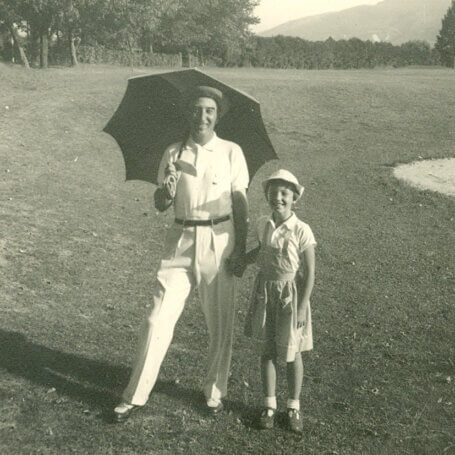
Catherine had started playing golf at the age of 8. The school term over, the family of six – there were three boys in addition to Catherine – would leave Paris for Chantaco, where they would spend their time playing tennis, golf and swimming. At 13, Catherine had nothing lower than a 24 handicap but, by the time she was 16, she went from a 6-handicapper to a 2 on her way to copying her mother in winning a French Girls’ championship. Such was her enthusiasm at that stage that she started practising her short game twice as much as her long game.
Catherine Lacoste began playing golf at age 8. Courtesy Catherine Lacoste
In 1964, when she was 18, she was called upon to play for France against England in a match at Deauville. Jill Thornhill, then 21 and later the winner of the 1983 British Women’s Amateur, cannot remember which side won, but she will never forget coming up against Catherine in the first round of the following week’s French championship. There is still an element of surprise in her voice as she recalls, “I somehow made it to the final after being lucky enough to beat the child prodigy in the first round … I’ve just done a bit of research on how old she was then, and discovered that she was 18. To me, she had seemed way younger than that – an amazingly talented teenager who was a bit off the planet and simply bubbling with life.”
Claudine Cros and Brigitte Varangot shepherded Catherine in the French side at the Women’s World Amateur Team Championship at St Germaine near Paris later that same season. They were a good five years older than she was and, said Catherine, “they beat me all the time.”
When their captain, the Vicomtesse de St-Sauveur, had to decide which of Cros and Lacoste should partner Varangot in the foursomes, she could think of no way better than to pit them against each other.
Catherine can remember Cros standing on the first tee and saying, “‘You’ve never beaten me yet.’
“Well, that was the day when I did beat her,” Catherine said.
It may not have mattered to anyone other than the two of them, but what made for big news was that France went on to defeat the U.S. team to win the event, with Catherine the leading individual.
Catherine Lacoste, the Vicomtesse de St-Sauveur, Brigitte Varangot and Claudine Cros at the 1964 Women’s World Amateur Team Championship. Courtesy Catherine Lacoste
Before the losing Americans set off for home, Mildred Prunaret, an influential voice on the USGA scene, had suggested to Catherine’s parents that they take their daughter to play in the 1965 U.S. Women’s Open at the Atlantic City Country Club.
Monsieur and Madame Lacoste liked the idea, and not least because the trip would revive many memories.
Back in 1927, 15 years after the sinking of the Titanic, René Lacoste had boarded the liner Ile-de-France for his return journey after winning the U.S. Open. Also on board was Simone Thion de la Chaume, a French amateur golfer who had been playing in the U.S. Women’s Amateur.
It so happened that Simone and her parents had been at Forest Hills when René defeated Bill Tilden, “the invincible American.” By all accounts, it was said that if René had changed tactics during the match, it was to impress the young lady in the stands. Indeed, the complicity between the two was so obvious that, by the time they disembarked in France, the press were already talking about the possibility of a romance.
René and Simone married in 1930 once René had recovered from a lingering dose of tuberculosis. Catherine, their only girl, was described by Seve as “the one who possessed the genius of golf.”
She finished 14th in that ’65 U.S. Women’s Open and, shortly afterwards, left the Sorbonne, one of the oldest and most famous universities in the world, to play full-time amateur golf, only without having it in mind to turn professional.
Linda Bayman, who won English, French and British amateur championships, besides running the players’ division of the English Ladies Golf Association, pointed out that Catherine didn’t need to turn professional, coming as she did from the Lacoste empire. “All she wanted was to become as good an amateur as she could be. She was brilliant and did more than anyone else to push the game forward. She changed the way we played long before Laura Davies came along.”
Soon, Catherine was asking her parents if she could go it alone to the 1967 U.S. Women’s Open. They couldn’t see why not.
“So I went on my own, at my request, taking a plane from Paris to Kennedy Airport and ended up doing the last leg in a helicopter because I was still only 21 and wasn’t allowed to drive.”
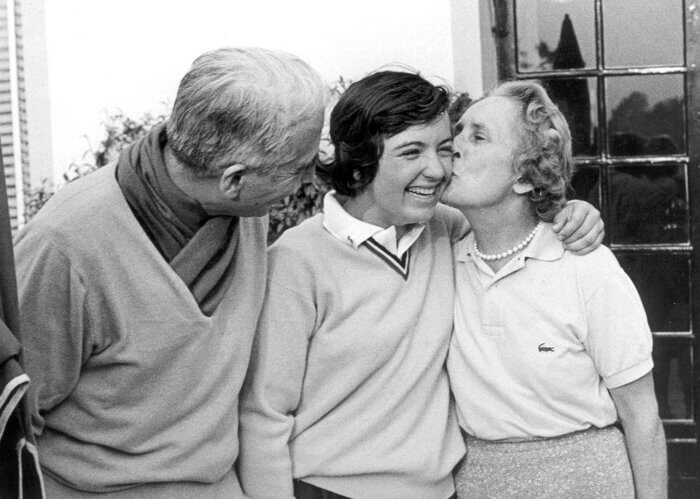
Catherine Lacoste with her parents René Lacoste and Simone Thion de la Chaume, 1964 Keystone-France, Gamma-Rapho via Getty Images
On arriving early at The Homestead after losing in the first round of the preceding British Women’s Amateur, she was able to make arrangements to play with Herman Perry, the head professional. And the more she practised alongside him, the better she got to know the course and its greens.
For another plus to that pre-championship week – and this, perhaps, is where the questions started as to why she and the LPGA professionals were not hanging out together – she spent most of her time in the Cascades Inn with a non-golfing family called the Prestons.
The Prestons had three children and, every day, Catherine would hurry back from golf to spend the rest of the day in the hotel swimming pool with the youngsters. Patty Berg was probably the only professional staying in that hostelry, with the rest of the players having opted for cabins around the course. Berg and Catherine certainly got on well, and they and the Prestons celebrated Catherine’s 22nd birthday during the tournament. Saturday wasn’t an early-to-bed night for Catherine. With her starting time on the Sunday an afternoon affair, she will tell you herself that she was dancing a Charleston well after midnight.
Jaime Prado y Colón, the Spaniard with whom she had four children – three girls and a boy, Caroline, Veronique, Geneviève and Juan Miguel – was a nice enough fellow but one who left it to his wife to keep the children busy.
It was Catherine who decided that they should learn the guitar and, after looking up “guitarists” in the Madrid telephone directory, she found an Angel G. Piñero. He agreed to tutor them and, very soon, Catherine joined the group.
Piñero was a composer as well as a tutor, and he was in the throes of completing twenty-two compositions for solo guitarists when he mumbled that he was composing music that he might never hear. At that, Catherine stepped in to organise concerts on his behalf.
Having purchased one of the earliest laptops and learned how to use it in a matter of minutes, she set up concerts around the world to let everyone know of his talent.
She and Piñero fell in love and, by 2002, the couple had shed their previous partners and married. Her parents had approved the match. “Play me a simple tune,” said René when he met Piñero in the 1990s. When Piñero obliged, René, who by then would have been in his 80s, offered to write the words to his music.
Angel G. Piñero Courtesy Catherine Lacoste
“Jaime, my first husband, gave me children but Piñero gave me love,” said Catherine, contentedly.
María Acacia, the Spaniard who retired eight years ago from running every press room in Europe for the DP World Tour, attended every one of the Piñero concerts.
“Catherine is an amazing lady,” said Acacia, who used to sit beside Catherine or Seve whenever they were being interviewed. “She arranges the most beautiful concerts and what amazes me as much as anything else is that she reached the top of world in golf, and that she reached that same level in extolling Piñero’s skills.”
Acacia knew nothing of Piñero’s death in February 2022 when she rang Catherine to ask if she would speak about Seve at a weekend convention in Santander.
“My husband died two days ago,” began a sad Catherine. There was then a brief pause before she thanked Acacia for the invitation and said that she would be honoured to talk about her old friend.
“She gave this wonderful speech,” Acacia said.
Intriguingly, Catherine had a bronze cast of Piñero’s hands made by the same artist, Juan Soler, who had made a cast of Seve’s, showing his grip on the club.
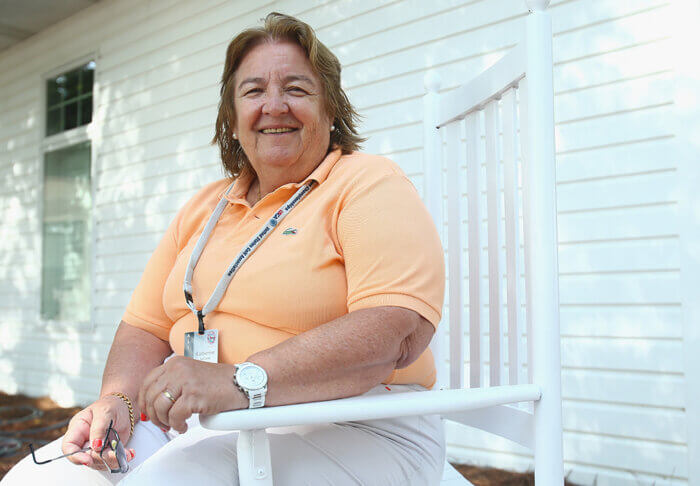
Catherine Lacoste, 2014 Scott Halleran, Getty Images
Back in 2015, when I went out to watch the Lacoste Ladies’ Open de France at Chantaco, Piñero would sit in the clubhouse looking admiringly at his wife as she played her part in keeping an eye on the tournament.
On the Friday morning, she drove me to the 11th green in a buggy – she by then had metal joints in her knees and was past playing golf – to see what the players were complaining about. Essentially, they had said that the two-tier putting surface was too difficult to hold. Putts and chips played from in front of the green had been rolling back to their feet and they thought it unfair.
Catherine’s view was that they were not armed with the same punch shots as the top players of her day. Having pondered on that, she took me on a tour of her favourite Chantaco views. There was one spectacular scene after another and, after pausing for a while on highest point of the lot, the 15th tee, she drove down a little tree-lined lane where her parents had liked to walk in their old age. Halfway down – and this could not have been more moving – she drew attention to the bench where they would sit in the evening sun. Catherine’s father died in 1996 and her mother in 2001.
Today, Catherine spends most of her time looking forward and, at the end of our most recent chat, she invited me to the concert she will be holding in 2031 in memory of Piñero.
It put me in mind of how, during the final of the ’69 U.S. Women’s Amateur at Las Colinas Country Club, she was anxious to sort out what should happen in the aftermath of the match.
Three up on Shelley Hamlin at a time when people might still have held out hope for the American, she fell into step with the USGA referee.
“When I’ve won,” she said, with her endearing brand of cheek, “how are you going to ship my trophy back to France?”
Rate this article
Average rating 2.9 / 3. Vote count: 22
We are sorry that this post was not useful for you!