

Editor’s Note: Second Wind is proud to publish the following excerpt from “Lonely Beauty,” historian David Normoyle’s recently published book chronicling the creation of Sand Hills Golf Club in Mullen, Nebraska, widely regarded as the course that sparked the minimalist design and remote golf destination movements. We hope you enjoy it.
Prologue: “I Like That”
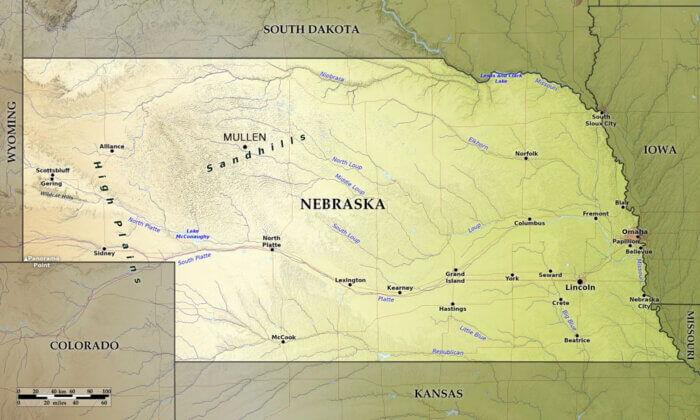
A peculiarity of tiny Mullen, Nebraska – population 554 as of the 1990 census – is that it has four 1st Streets, but no stoplight.
Separated by Mullen’s lone railroad crossing, roughly where Nebraska State Highways 97 and 2 meet, one’s destination in this village of less than 0.5 square miles might be Northeast 1st Street, heading toward Sandhill Fertilizer. Or it could be Northwest 1st Street, heading toward the United Methodist Church. Maybe it’s Southeast 1st Street, heading out of town on Route 2 towards Thedford, or, most likely, Southwest 1st Street, the location of Mullen’s true center: Big Red’s cafe.
Where you’re going depends on where you happen to be, relative to that central railroad crossing. After all, Mullen itself came about through the establishment of the railroad and was named in recognition of Charles D. Mullen, a minor official in the Chicago, Burlington & Quincy Railroad, which brought the line through in 1887.
For a place whose motto is, “The Biggest Little Town in Hooker County,” with a population that peaked in 1960 with 811 residents, this street-naming peculiarity doesn’t seem to present too much of a concern for local folks, if they even notice.
What does create an impediment, however, is when the Wyoming coal train – all two-hundred-plus cars of it – rumbles slowly through town, heading to, or from, points east. When that happens, it doesn’t matter which part of 1st Street you’re trying to get to. Or from. You won’t get there until the train passes.
One day, in the summer of 1992, a forty-six-year-old golf architect named Bill Coore was driving to work at the Sand Hills Golf Club. His task that day was to flag future fairway contours and stake potential irrigation lines for this new golf course being built twelve miles south of town. Until he was stopped cold by the Wyoming coal train on its regular route through Mullen.
“You’ve got nowhere to go,” recalled Coore during a conversation in the library of the Sand Hills Golf Club, nearly thirty years later. “You just have to sit there until the train goes by.”
“So, I’m sitting there,” he continued in a soft, courtly North Carolina accent, “waiting on the train to go by, and there’s a pickup truck behind me. I look in the mirror – this is really early; we hadn’t even started construction – and I see this guy. He gets out of his truck. He starts walking towards me.”
The man walked up beside Bill Coore’s truck. It was during the summer, so Coore had the windows rolled down. The man looked at the salt-and-pepper-haired architect – and especially his clothes that were not fit for ranching – and said, “You must be one of them golf course fellas.”
Coore replied, “Yes, sir, I am.”
“Reckon you’ll be building a course out there,” the man said.
“Well, we hope to,” offered Coore humbly.
“Reckon it’ll be looking like those things we see on television,” the local man said. “Lots of green grass. Lakes. Trees. Some houses. …”
His voice trailed off, describing a “Palm Springs-type situation.”
“No, sir, not if we can help it,” Coore responded. “It’s going to look just like the ground you see – maybe with more closely mowed grass. Not too green. You’d still recognize the ground when you go out there – other than the fact there will be people playing golf on it. We hope.”
“No trees?” the man asked.
“No trees,” Coore replied.
“No water?”
“No water.”
“No houses?”
“No houses.”
“Well, what then …” the man stammered and stood there. He looked at Coore. Finally, he muttered, “Hmm. I like that. I like that.”
The man turned around without saying another word, walked back, and got in his pickup truck.
Bill Coore sat there for another twenty minutes, alone in his thoughts as he waited for the coal train to pass by.