

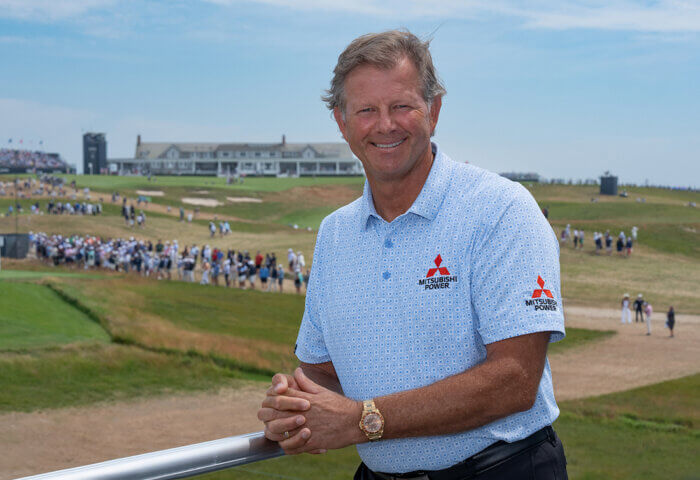
SOUTHAMPTON, NEW YORK | Long after the fog had lifted to reveal a lowering sky punctuated occasionally by patches of blue, Retief Goosen settled in his seat in a hospitality unit overlooking the 17th hole at Shinnecock Hills. As he cast his mind back to the 2004 U.S. Open at the highly regarded course far out on the east end of Long Island, a smile spread slowly over his suntanned face. Little wonder. That was the year he won his second U.S. Open, three years after his first, at Southern Hills in Tulsa, Oklahoma.
In 2004 Goosen held a clear lead after 54 holes with Ernie Els, his countryman, and Phil Mickelson two strokes behind. Els double-bogeyed the first hole and never got back into contention. Mickelson took the lead on the 16th only to three-putt the 17th from 5 feet for a double bogey. “Phil made a mistake, I didn’t. Lucky for me,” Goosen, 57, said.
“It’s great coming back to a place where you have always won,” Goosen continued. “I would have loved to have been inside the ropes today and I did think about trying to qualify but then I thought, ‘No, I’ve done that.’”
He looked out of the window down onto the fourth green which, even from his eyrie of perhaps 30 feet above ground, still looked enormous and forbidding. Moments earlier Rory McIlroy had recovered from an off-line second shot that ended 25 yards to the right of the putting surface to scramble for a par. One playing partner, Tommy Fleetwood, clad all in brown, holed on this green for a birdie.

By now the flags were fluttering in a strong wind that had blown away all traces of the fog that caused the start of the first day’s play to be delayed by two hours. “I’ve got great memories of here,” Goosen said. “I don’t remember all the shots – just the good ones.”
There were more than a few of those, particularly his 11 single putts in his fourth round. In a TV interview during the morning’s fog delay Pádraig Harrington had commented on Goosen’s skill on the greens. “It was one of the greatest putting rounds ever,” Harrington said.
The Irishman also singled out Goosen’s calmness and cast of mind that week, noting how composed he seemed even after a bad shot. On hearing this Goosen said: “Thank you very much. That’s quite a compliment from a guy who has won three majors, but it’s true. At the time I did have a good mindset.
“When I got there at the beginning of the week I felt very comfortable. In my Monday practice round I liked the whole thing. On Thursday and Friday the greens were fine and on Saturday and Sunday they flipped around. They were very tricky. At the weekend it was all about hanging on.
“I was working hard on the mental side of the game at that time and really played some great golf in that period. Everybody on the driving range hits it 300 yards and one guy shoots 64 and another guy shoots 74 so yes, there is quite a mental aspect to it. Some of the greatest players in the world have had great minds.”
At this he paused and smiled. “It was 22 years ago, though. I haven’t the patience anymore.”
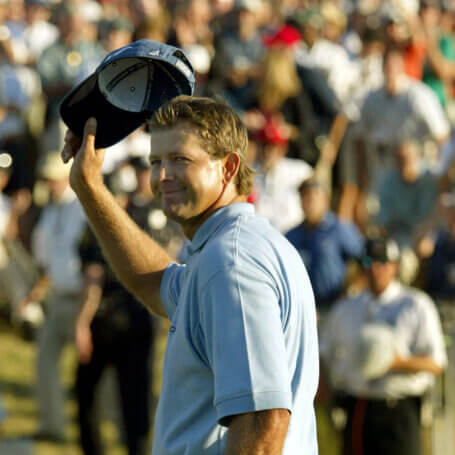
Goosen was blessed with a build to withstand wind and a mind to repel adversity. Little disturbed him then and he gives every impression that little disturbs him now. At his best his swing was slow and elegant, his walk that of a man strolling along the seafront without a care in the world. And his putting stroke was smooth as silk, precise and firm. Everything about him was of a piece – quiet and understated. Even when he holed his putt for victory 22 years ago he did little more than smile, take his cap off and wave.
Who will join him this week as the sixth winner of a U.S. Open at one of the country’s most distinguished and feared courses? Goosen should know better than most. “I am leaning towards a lower ball-flighting guy, somebody who can really knock it down. Brooks [Koepka] and Gary Woodland can really hit it low for example. Rory [McIlroy], obviously he knows everything about this kind of weather. These guys are really performing. They can hook it and fade it up against this wind.” As Goosen spoke, McIlroy moved to 3-under par before finishing one under.
“At the beginning of the week I thought Cameron Young was a good shot. He was playing well and has a large amount of patience. He looks calm and as though nothing fazes him on a golf course. Scottie [Scheffler] is similar. He doesn’t show a lot on a golf course. He makes a lot of birdies. A lot depends on the wind. Someone who is under [par] now might find that is the winning score. Who knows?”
He tugged at the left sleeve of his sweater to reveal one of the prizes he received for his first U.S. Open victory, the one at Southern Hills. It was a Rolex watch and it marked the start of his 25 years as a testimonee for that company. When he took it off you could see the words engraved on the back: U.S. Open champion 2001. “Not bad is it?” he said in that slow way of his. “Not bad.”