


Golf is not the easiest sport for a kid. It’s usually hot and sticky outside, the rules are difficult to understand, and the sport is just downright hard. But as we age, we learn about the many ways golf can enhance your life.
As a child, Isabella DiLisio initially had no interest in golf despite the encouragement from her parents. But then, at age 9, something clicked for this young girl from Hatfield, Pennsylvania.
DiLisio’s parents, Dina and Sam, were stunned when Isabella refused to stay at her grandparent’s house one afternoon when they were going to play golf. Three years earlier, they had introduced their athletic daughter to golf, signing her up for a local camp — and she hated it.

“I did this one-week golf camp in the summer, and then the clubs were put away,” DiLilsio said. “But randomly one day I just wanted to go play golf with my parents. I threw a temper tantrum when they were trying to leave me at my grandparents’.”
Despite reminding Isabella she didn’t like golf, Dina and Sam took her to a local public course to play nine holes with them.
“I loved it,” DiLisio said. And in the summers to come, Dina and Sam got their daughter a junior membership at Talamore Country Club in Pennsylvania. All of a sudden, golf became fun.
DiLisio started playing in U.S. Kids tournaments right away, a recommendation by the head pro at Talamore, who saw her potential. Competing in U.S. Kids at a young age had two benefits. First, it channeled her competitiveness, which would eventually lead to a college scholarship. Second, and more importantly, she had the chance to be around other girls who played golf.
“I see so many more young girls now with their families later in the day on the range, or doing the junior camps in the summer, and it’s just really nice to see. I don’t remember seeing that when I was young.” — Isabella DiLisio
“The club I was a member at had a ton of junior members, and that’s why we picked it,” DiLisio said. “It was also mostly boys, and I was the only girl. When I was 12, I was playing with a bunch of 12- to 16- year-old boys. It was definitely helpful because they could all hit the ball far and were really good players. But there’s something about seeing yourself in someone who’s older than you.
“Even now with my job, I naturally get inspired by women who are doing what I want to be doing in my career eventually. It’s easier to feel like there’s a path to get there when you see another woman achieve a goal that you have. I see so many more young girls now with their families later in the day on the range, or doing the junior camps in the summer, and it’s just really nice to see. I don’t remember seeing that when I was young.”
When DiLisio was 16, she served as a standard bearer for the 2013 U.S. Open at Merion Golf Club. She had no way of knowing that her family would be making a historic discovery during that U.S. Open week. It involved golf great Ben Hogan.
“When I first started playing golf, my Nana told us that her father caddied for Ben Hogan,” Dilisio recalled. “But she had no idea where and no idea when, because she had zero interest in golf. Her dad just happened to be a local caddie, and she remembered watching him with Ben Hogan on TV.”
During the legendary 1950 U.S. Open, Hogan was vying for the title after miraculously surviving a car accident 16 months prior. He was playing well by the final day but was struggling with an illness and told his caddie to put his clubs by the clubhouse, which was right next to the 13th hole. Hogan did not believe he could finish his round.
Hogan’s caddie, Nick Ciocca, looked at Hogan and said: “I’m sorry, Mr. Hogan. I don’t caddie for quitters. I’ll see you on the next tee.”
“That was my great-grandfather,” said DiLisio. “Apparently Hogan was so shocked by his response that he didn’t know what to do and just kept walking. A couple of holes later, he hits the famous 1-iron on 18 and goes on to win in the playoff the next day.”
The DiLisio family learned all this from the historian at Merion, John Capers III, who, by coincidence, spent the 2013 U.S. Open trying to figure out who Hogan’s mysterious caddie was all those years ago.
“We brought pictures of my great-grandfather,” DiLisio said. “(Capers) had pictures of the caddie, and he put our pictures next to his. And he confirmed my great-grandfather was Hogan’s caddie.”
“I just didn’t really want to play anymore, and I wasn’t enjoying it. That was the scary part for me. I would go to a tournament and wake up in the morning and think, ‘I don’t want to play golf today. This is getting really hard.’ ” — Isabella DiLisio
Discovering that her great-grandfather had caddied for one of the all-time greats during an iconic U.S. Open victory was the springboard that propelled DiLisio to earn a college golf scholarship.
“Growing up knowing that I had someone in my family who was a good golfer was so helpful for me because I felt if he could do it, then I could do it,” DiLisio said. “Once we found out everything about the 1950 U.S. Open, I felt I needed to keep the legacy going.”
Two years later, in 2015, Dilisio joined the Fighting Irish as a freshman on the Notre Dame women’s golf team. Like most incoming freshmen, she quickly learned the ropes of managing the life of a student-athlete. She also assumed professional golf would be her career after college.
“I thought of (professional golf) as a natural progression from junior to college to then playing professionally,” DiLisio said. But she noted that the injuries started piling up her senior year, especially with her back.
“I just didn’t really want to play anymore, and I wasn’t enjoying it,” she recalled. “That was the scary part for me. I would go to a tournament and wake up in the morning and think, ‘I don’t want to play golf today. This is getting really hard.’
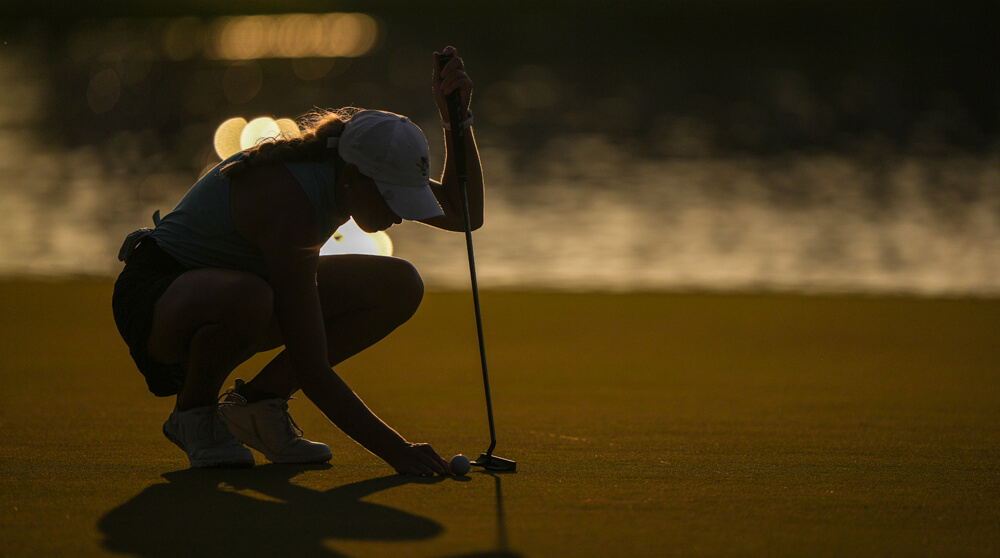
“But I learned a lot about perseverance in battling those injuries,” DiLisio continued. “I wanted to play well, but my body wasn’t allowing me all the time. That kind of stuff was hard. It definitely was a huge growing experience for those four years.”
During this growth period, DiLisio had a decision to make: Should she turn professional, the path expected of her by most people? Or should she accept a sales job at Aetna, the health insurance company she’d had an internship with over the summer?
“I ended up asking for an extension to accept the job because I was so split down the middle,” DiLisio said. “But then a light bulb went off and I was like, ‘I’m going to take the job. I’m burned out in golf. Everything hurts. It probably doesn’t make sense health-wise for me to go to Q-school.’
“The day I accepted the job, I felt the biggest weight lifted off my shoulders. I felt like I finally had made a good decision. It was hard because I felt like I was letting other people down by not trying to turn pro. But when I finally made the decision for myself and just forgot what everybody else was thinking, it was so freeing, and I really enjoyed my last spring season. I actually felt happy to be out there playing again.”
“I probably love golf more than I ever have at this stage of my life.” — Isabella DiLisio
Since graduating from Notre Dame and joining the Philadelphia Cricket Club, where she became a three-time club champion (2020-2022), DiLisio has made golf a central part of her work-life balance. She plays any chance she gets with members and friends, and golf has become a stress reliever from work.
DiLisio has also remained competitive. The moment she turned 25 last year, she signed up for the U.S. Women’s Mid-Amateur and advanced to the semifinals. Since then, she’s played in the U.S. Women’s Four-Ball, with partner Jackie Rogowicz, and the Canadian Women’s Mid-Amateur.
“Mid-Am golf is the greatest thing ever,” DiLisio said. “The tournaments are so fun. Everybody’s just at very similar points in life.”
Forgoing a professional golf career has led to opportunities and life experiences DiLisio could never have imagined before going to college. She plays for fun. She plays with clients. And she still gets to play competitively.
“I probably love golf more than I ever have at this stage of my life.”